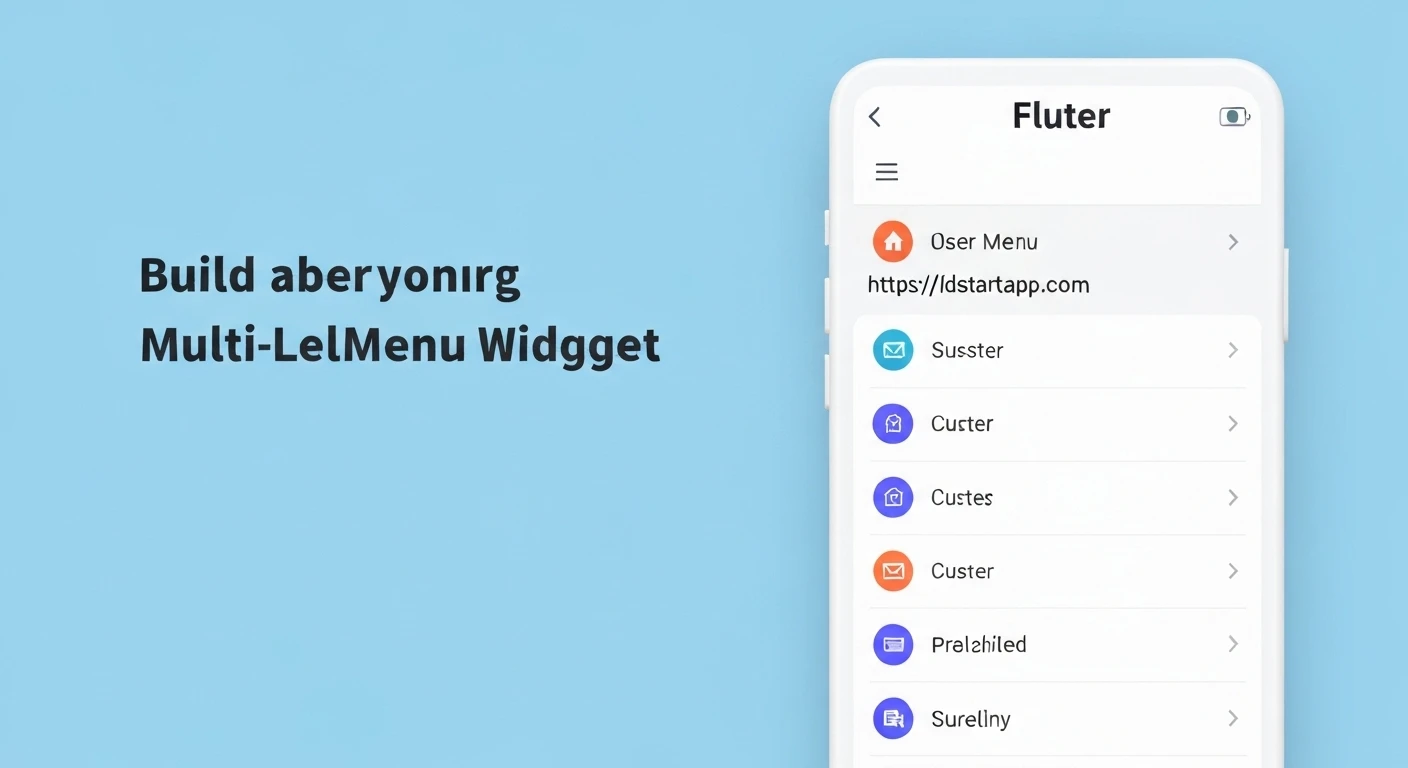

Creating a Multi-Level Menu Widget in Flutter
Building intuitive navigation is crucial for any application, and a multi-level menu often serves as an elegant solution for organizing complex hierarchies of features or content. In Flutter, creating such a widget can be achieved efficiently by combining Flutter's declarative UI capabilities with a recursive approach to handle arbitrary levels of depth. This article will guide you through the process of developing a reusable multi-level menu widget.
Understanding the Core Concept
A multi-level menu essentially consists of menu items that can either trigger an action directly or expand to reveal a sub-menu of further items. This hierarchical structure lends itself well to a recursive widget design, where a menu item widget renders itself and, if it has children, recursively renders instances of the same menu item widget for its children.
Flutter's
ExpansionTileDefining the Menu Item Data Structure
First, let's define a data model for our menu items. This class will hold the title, an optional icon, an optional callback for when the item is tapped, and crucially, a list of
MenuItem
import 'package:flutter/material.dart';

class MenuItem {
  final String title;
  final IconData? icon;
  final List? children;
  final VoidCallback? onTap;

  MenuItem({
    required this.title,
    this.icon,
    this.children,
    this.onTap,
  });

  bool get hasChildren => children != null && children!.isNotEmpty;
}
The
hasChildrenImplementing the Multi-Level Menu Widget
Now, let's create the widget that will render each
MenuItem
import 'package:flutter/material.dart';

class MultiLevelMenuItem extends StatelessWidget {
  final MenuItem item;
  final double indentLevel; // Used to visually indent child items

  const MultiLevelMenuItem({
    Key? key,
    required this.item,
    this.indentLevel = 0,
  }) : super(key: key);

  @override
  Widget build(BuildContext context) {
    // Determine the padding for visual indentation
    final EdgeInsetsGeometry padding = EdgeInsets.only(left: indentLevel);

    if (item.hasChildren) {
      return Padding(
        padding: padding,
        child: ExpansionTile(
          leading: item.icon != null ? Icon(item.icon) : null,
          title: Text(item.title),
          children: item.children!
              .map((child) => MultiLevelMenuItem(
                    item: child,
                    indentLevel: indentLevel + 16.0, // Increase indent for children
                  ))
              .toList(),
        ),
      );
    } else {
      return Padding(
        padding: padding,
        child: ListTile(
          leading: item.icon != null ? Icon(item.icon) : null,
          title: Text(item.title),
          onTap: item.onTap,
        ),
      );
    }
  }
}
In this
MultiLevelMenuItem- We accept a
object as a required parameter.MenuItem - We introduce an
property to control the visual offset for nested items, making the hierarchy clear.indentLevel - If
is true, we return anitem.hasChildren
. TheExpansionTile
of thechildren
are populated by recursively callingExpansionTile
for each child item, incrementing theMultiLevelMenuItem
.indentLevel - If there are no children, we return a standard
which triggers theListTile
callback when pressed.onTap
Example Usage
To demonstrate how to use the
MultiLevelMenuItem
import 'package:flutter/material.dart';
// Assuming MenuItem and MultiLevelMenuItem classes are in the same project or imported.
// import 'menu_item.dart';
// import 'multi_level_menu_item.dart';

void main() {
  runApp(const MyApp());
}

class MyApp extends StatelessWidget {
  const MyApp({Key? key}) : super(key: key);

  @override
  Widget build(BuildContext context) {
    return MaterialApp(
      title: 'Multi-Level Menu Demo',
      theme: ThemeData(
        primarySwatch: Colors.blue,
      ),
      home: const MyHomePage(),
    );
  }
}

class MyHomePage extends StatefulWidget {
  const MyHomePage({Key? key}) : super(key: key);

  @override
  State createState() => _MyHomePageState();
}

class _MyHomePageState extends State {
  // Sample data for our multi-level menu
  final List _menuItems = [
    MenuItem(
      title: 'Dashboard',
      icon: Icons.dashboard,
      onTap: () => print('Dashboard tapped'),
    ),
    MenuItem(
      title: 'Products',
      icon: Icons.shopping_bag,
      children: [
        MenuItem(
          title: 'All Products',
          onTap: () => print('All Products tapped'),
        ),
        MenuItem(
          title: 'Categories',
          children: [
            MenuItem(
              title: 'Electronics',
              onTap: () => print('Electronics tapped'),
            ),
            MenuItem(
              title: 'Books',
              onTap: () => print('Books tapped'),
            ),
            MenuItem(
              title: 'Clothing',
              children: [
                MenuItem(
                  title: 'Men\'s',
                  onTap: () => print('Men\'s Clothing tapped'),
                ),
                MenuItem(
                  title: 'Women\'s',
                  onTap: () => print('Women\'s Clothing tapped'),
                ),
              ],
            ),
          ],
        ),
        MenuItem(
          title: 'Add New Product',
          onTap: () => print('Add New Product tapped'),
        ),
      ],
    ),
    MenuItem(
      title: 'Orders',
      icon: Icons.receipt,
      children: [
        MenuItem(
          title: 'Pending Orders',
          onTap: () => print('Pending Orders tapped'),
        ),
        MenuItem(
          title: 'Completed Orders',
          onTap: () => print('Completed Orders tapped'),
        ),
      ],
    ),
    MenuItem(
      title: 'Settings',
      icon: Icons.settings,
      children: [
        MenuItem(
          title: 'Profile',
          onTap: () => print('Profile tapped'),
        ),
        MenuItem(
          title: 'Privacy',
          onTap: () => print('Privacy tapped'),
        ),
        MenuItem(
          title: 'About',
          onTap: () => print('About tapped'),
        ),
      ],
    ),
    MenuItem(
      title: 'Logout',
      icon: Icons.logout,
      onTap: () => print('Logout tapped'),
    ),
  ];

  @override
  Widget build(BuildContext context) {
    return Scaffold(
      appBar: AppBar(
        title: const Text('Multi-Level Menu'),
      ),
      body: ListView(
        children: _menuItems
            .map((item) => MultiLevelMenuItem(item: item))
            .toList(),
      ),
    );
  }
}
In this example, a
ListViewMenuItemMultiLevelMenuItemConclusion
By leveraging Flutter's
ExpansionTileMultiLevelMenuItem