
Flutter Slide and Bounce Animations for Interactive List Items
User experience is paramount in modern mobile application development. Engaging animations not only make an app visually appealing but also provide intuitive feedback, guiding users through interactions. Flutter, with its powerful and flexible animation framework, allows developers to create stunning, performant animations with relative ease. This article explores how to implement slide and bounce animations for interactive list items, enhancing the dynamism and responsiveness of your Flutter applications.
The Power of Animations in List Views
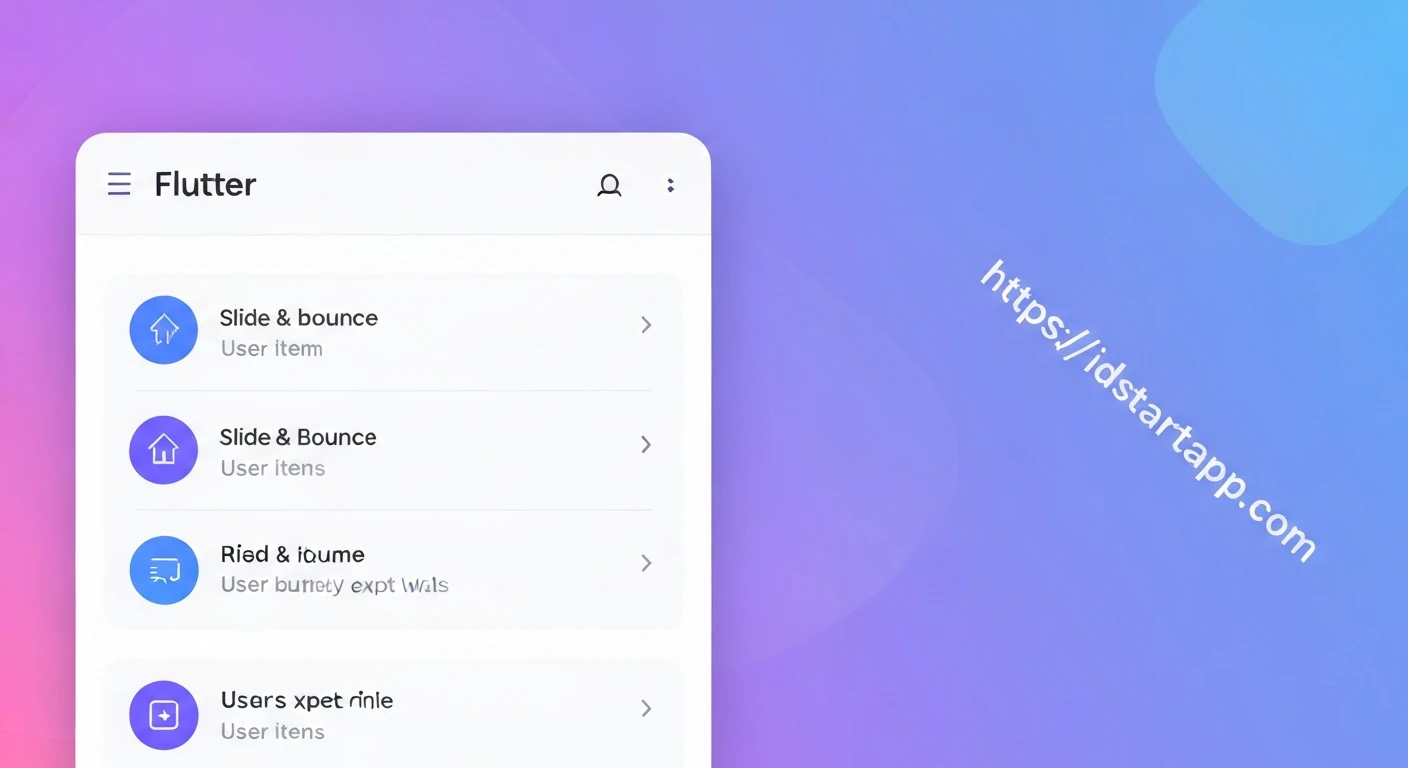
List views are fundamental components in almost every application. Whether displaying articles, products, or messages, a static list can feel dull. Introducing animations, such as items sliding into view or bouncing slightly upon interaction, transforms a mundane list into a vibrant and engaging experience. These subtle effects can significantly improve perceived performance and user satisfaction.
Core Flutter Animation Concepts
Before diving into the code, let's briefly recall the essential building blocks for animations in Flutter:
AnimationController: Manages the animation's progress, duration, and lifecycle (start, stop, reverse).Tween: Defines the range of values an animation can interpolate between (e.g., from 0.0 to 1.0, or from anOffset(0,0)toOffset(0.5,0)).Animation: Represents the current value of the animation at any given time, driven by anAnimationControllerand often transformed by aTween.Curve: Defines the non-linear progression of an animation (e.g.,Curves.easeOut,Curves.bounceOut,Curves.elasticOut).AnimatedBuilder/Transition Widgets: Widgets likeSlideTransition,ScaleTransition,FadeTransitionautomatically rebuild their child widget based on the animation's value, making it easier to apply transformations.
Implementing a Slide Animation for List Items
A slide animation can be used when an item appears, disappears, or is moved horizontally/vertically. We'll focus on an item sliding into view from the side.
First, create a basic list item widget that can be animated:
import 'package:flutter/material.dart';

class AnimatedListItem extends StatefulWidget {
  final String title;
  final int index;

  const AnimatedListItem({Key? key, required this.title, required this.index}) : super(key: key);

  @override
  _AnimatedListItemState createState() => _AnimatedListItemState();
}

class _AnimatedListItemState extends State with SingleTickerProviderStateMixin {
  late AnimationController _controller;
  late Animation _slideAnimation;

  @override
  void initState() {
    super.initState();
    _controller = AnimationController(
      vsync: this,
      duration: Duration(milliseconds: 500),
    );

    _slideAnimation = Tween(
      begin: Offset(1.0, 0.0), // Start from right outside the screen
      end: Offset.zero,       // End at its normal position
    ).animate(CurvedAnimation(
      parent: _controller,
      curve: Curves.easeOutCubic, // A smooth easing curve
    ));

    // Stagger animation based on index for a cascading effect
    Future.delayed(Duration(milliseconds: widget.index * 100), () {
      if (mounted) {
        _controller.forward();
      }
    });
  }

  @override
  void dispose() {
    _controller.dispose();
    super.dispose();
  }

  @override
  Widget build(BuildContext context) {
    return SlideTransition(
      position: _slideAnimation,
      child: Card(
        margin: EdgeInsets.symmetric(horizontal: 16.0, vertical: 8.0),
        elevation: 4.0,
        child: ListTile(
          leading: CircleAvatar(child: Text('${widget.index + 1}')),
          title: Text(widget.title),
          subtitle: Text('This is an interactive item.'),
          onTap: () {
            // Placeholder for interactivity
            print('Tapped on ${widget.title}');
          },
        ),
      ),
    );
  }
}
In this example, each AnimatedListItem initializes its own AnimationController and a Tween that slides the widget from Offset(1.0, 0.0) (one screen width to the right) to Offset.zero (its original position). The CurvedAnimation with Curves.easeOutCubic provides a smooth acceleration and deceleration. The Future.delayed call staggers the animation for each item, creating a pleasant cascading effect as the list loads.
Integrating a Bounce Effect
A bounce effect typically involves scaling or slight displacement, giving a playful or emphatic feel. We can achieve this using a ScaleTransition and a bounce-specific Curve, or by integrating it directly into the SlideTransition's curve. For an interactive bounce, like on a tap, a separate AnimationController or a reactive approach works well.
Let's modify our AnimatedListItem to include a subtle bounce when it's tapped:
import 'package:flutter/material.dart';

class InteractiveListItem extends StatefulWidget {
  final String title;
  final int index;

  const InteractiveListItem({Key? key, required this.title, required this.index}) : super(key: key);

  @override
  _InteractiveListItemState createState() => _InteractiveListItemState();
}

class _InteractiveListItemState extends State with TickerProviderStateMixin {
  late AnimationController _appearController; // For initial slide-in
  late Animation _slideAnimation;

  late AnimationController _bounceController; // For tap bounce effect
  late Animation _scaleAnimation;

  @override
  void initState() {
    super.initState();

    // Animation for initial slide-in
    _appearController = AnimationController(
      vsync: this,
      duration: Duration(milliseconds: 500),
    );
    _slideAnimation = Tween(
      begin: Offset(1.0, 0.0),
      end: Offset.zero,
    ).animate(CurvedAnimation(
      parent: _appearController,
      curve: Curves.easeOutCubic,
    ));

    // Staggered slide-in
    Future.delayed(Duration(milliseconds: widget.index * 100), () {
      if (mounted) {
        _appearController.forward();
      }
    });

    // Animation for bounce on tap
    _bounceController = AnimationController(
      vsync: this,
      duration: Duration(milliseconds: 200), // Quick bounce
      lowerBound: 0.8, // Minimum scale (for a subtle "press in" effect)
      upperBound: 1.0, // Normal scale
    );
    // Use an elastic curve for the "bounce back" effect
    _scaleAnimation = Tween(begin: 1.0, end: 1.0).animate(
      CurvedAnimation(
        parent: _bounceController,
        curve: Curves.elasticOut, // Elastic curve for a natural bounce
      ),
    );
  }

  @override
  void dispose() {
    _appearController.dispose();
    _bounceController.dispose();
    super.dispose();
  }

  void _handleTap() {
    _bounceController.reverse().then((_) { // Scale down
      _bounceController.forward();         // Bounce back
    });
    print('Tapped on ${widget.title}');
    // Add your desired action here
  }

  @override
  Widget build(BuildContext context) {
    return SlideTransition(
      position: _slideAnimation,
      child: ScaleTransition(
        scale: _scaleAnimation,
        child: GestureDetector(
          onTap: _handleTap,
          child: Card(
            margin: EdgeInsets.symmetric(horizontal: 16.0, vertical: 8.0),
            elevation: 4.0,
            child: ListTile(
              leading: CircleAvatar(child: Text('${widget.index + 1}')),
              title: Text(widget.title),
              subtitle: Text('Tap me for a bounce!'),
            ),
          ),
        ),
      ),
    );
  }
}
In this refined version, we use two AnimationController instances: _appearController for the initial slide-in and _bounceController for the tap interaction. The _bounceController is configured with lowerBound: 0.8 and upperBound: 1.0, allowing us to reverse it to scale down to 0.8 and then forward it to bounce back to 1.0 using Curves.elasticOut. The GestureDetector wraps the Card, triggering _handleTap on tap, which orchestrates the bounce animation.
Putting It All Together: A List of Interactive Items
To see these animated items in action, create a simple ListView.builder:
import 'package:flutter/material.dart';
// Assuming InteractiveListItem is defined in interactive_list_item.dart
import 'interactive_list_item.dart';

class AnimatedListScreen extends StatelessWidget {
  final List _items = List.generate(20, (index) => 'Item ${index + 1}');

  AnimatedListScreen({Key? key}) : super(key: key);

  @override
  Widget build(BuildContext context) {
    return Scaffold(
      appBar: AppBar(
        title: Text('Animated List'),
      ),
      body: ListView.builder(
        itemCount: _items.length,
        itemBuilder: (context, index) {
          return InteractiveListItem(
            title: _items[index],
            index: index,
          );
        },
      ),
    );
  }
}
When you run this application, you'll observe each list item sliding in from the right with a smooth effect, staggered by their index. Tapping any item will trigger a delightful bounce animation, providing immediate and engaging visual feedback to the user.
Best Practices and Considerations
- Performance: While Flutter animations are highly optimized, be mindful of animating too many complex widgets simultaneously, especially on older devices. Use
constconstructors where possible to prevent unnecessary rebuilds. - Accessibility: Ensure animations are not too fast or disorienting. Provide options for users to reduce motion if necessary.
- Timing and Curves: Experiment with different durations and
Curvesto find the most natural and pleasing animation for your specific use case. Subtle animations are often more effective than exaggerated ones. - State Management: For more complex interactions or shared state, consider integrating animations with your preferred state management solution (Provider, BLoC, Riverpod, etc.).
Conclusion
Implementing slide and bounce animations for interactive list items in Flutter significantly elevates the user experience. By leveraging Flutter's powerful animation framework, developers can create applications that are not just functional but also delightful and intuitive to use. The techniques demonstrated here provide a solid foundation for building engaging and responsive interfaces, making your Flutter apps stand out.