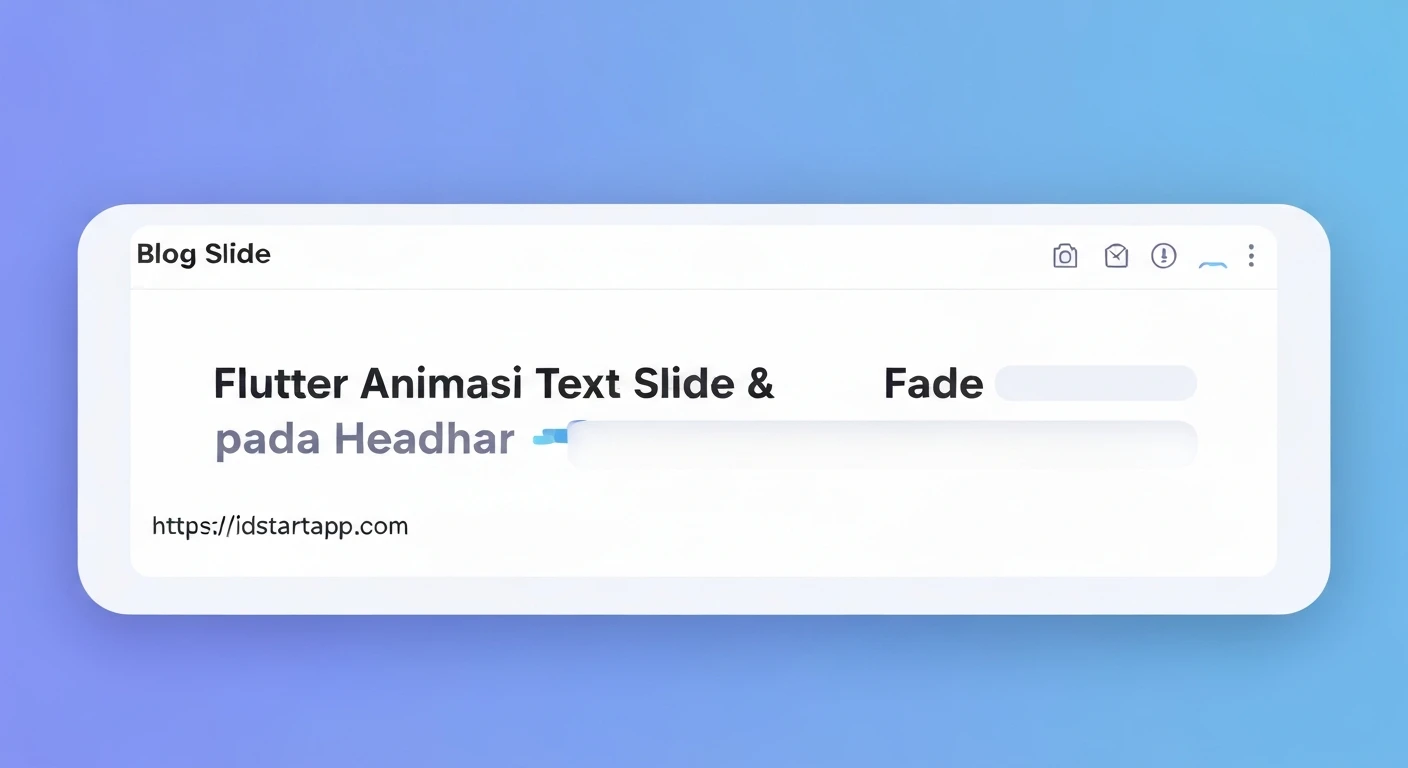

Flutter: Crafting Engaging Header Text Animations with Slide and Fade Effects
Dynamic and visually appealing user interfaces are crucial for modern mobile applications. In Flutter, animating UI elements can significantly enhance user experience and engagement. A common yet effective animation technique is to cycle through header text with a smooth slide and fade effect, making your app feel more lively and interactive. This article will guide you through implementing such an animation in your Flutter header.
Why Animate Header Text?
Animating header text serves several purposes beyond just aesthetics:
- User Engagement: Dynamic content naturally draws the user's eye and maintains interest.
- Information Display: Cycle through important messages, promotions, or status updates without taking up too much screen real estate.
- Brand Identity: A polished animation reflects attention to detail and a modern design sensibility.
- Enhanced UX: Provides a clear visual cue when content changes, making the transition feel seamless rather than abrupt.
Core Concepts and Widgets
To achieve the desired slide and fade effect, we'll leverage a combination of Flutter's animation widgets:
StatefulWidget:To manage the changing text content and trigger UI updates.AnimatedSwitcher:The star of the show. It automatically animates the transition between its old and new children. It's perfect for scenarios where you replace one widget with another.SlideTransition:A widget that animates the position of its child. We'll use this to make the text slide in and out.FadeTransition:A widget that animates the opacity of its child, allowing the text to fade in and out.TweenandTween:Used withSlideTransitionandFadeTransitionto define the start and end values for the animation.Timer:To automatically trigger text changes at regular intervals.
Step-by-Step Implementation
Let's break down the process into manageable steps.
1. Project Setup and Basic StructureStart with a basic Flutter application. We'll focus on a single StatefulWidget that holds our header text and animation logic.
import 'dart:async';
import 'package:flutter/material.dart';

void main() {
  runApp(const MyApp());
}

class MyApp extends StatelessWidget {
  const MyApp({super.key});

  @override
  Widget build(BuildContext context) {
    return MaterialApp(
      title: 'Flutter Animated Header',
      theme: ThemeData(
        primarySwatch: Colors.blue,
      ),
      home: const AnimatedHeaderTextScreen(),
    );
  }
}

class AnimatedHeaderTextScreen extends StatefulWidget {
  const AnimatedHeaderTextScreen({super.key});

  @override
  State createState() => _AnimatedHeaderTextScreenState();
}

class _AnimatedHeaderTextScreenState extends State {
  // ... animation logic will go here
  @override
  Widget build(BuildContext context) {
    return Scaffold(
      appBar: AppBar(
        title: const Text('Dynamic Header'),
      ),
      body: Center(
        child: Column(
          mainAxisAlignment: MainAxisAlignment.center,
          children: [
            // Animated Header Text will go here
            const SizedBox(height: 20),
            ElevatedButton(
              onPressed: () {
                // Example: Navigate to another screen or perform an action
              },
              child: const Text('Main Content'),
            ),
          ],
        ),
      ),
    );
  }
}
We'll create a list of strings to cycle through and maintain the current index. A Timer will be used to automatically update the text.
// ... (inside _AnimatedHeaderTextScreenState class)
class _AnimatedHeaderTextScreenState extends State {
  final List<String> _headerTexts = [
    "Welcome to Our App!",
    "Explore New Features!",
    "Check Out Our Latest Deals!",
    "Your Journey Starts Here!",
  ];
  int _currentTextIndex = 0;
  Timer? _timer;

  @override
  void initState() {
    super.initState();
    _startTextAnimation();
  }

  @override
  void dispose() {
    _timer?.cancel(); // Cancel the timer when the widget is disposed
    super.dispose();
  }

  void _startTextAnimation() {
    _timer = Timer.periodic(const Duration(seconds: 4), (timer) {
      setState(() {
        _currentTextIndex = (_currentTextIndex + 1) % _headerTexts.length;
      });
    });
  }

  String get _currentText => _headerTexts[_currentTextIndex];

  // ... (build method)
}
AnimatedSwitcher with Custom Transition
The AnimatedSwitcher will observe changes in its child widget (identified by a unique Key). When the child changes, it triggers the animation defined by its transitionBuilder. We'll combine SlideTransition and FadeTransition here.
The transitionBuilder receives the new child and an Animation<double> that goes from 0.0 to 1.0 for the incoming child, and implicitly from 1.0 to 0.0 for the outgoing child.
// ... (inside _AnimatedHeaderTextScreenState class's build method)
class _AnimatedHeaderTextScreenState extends State {
  // ... (previous code)

  @override
  Widget build(BuildContext context) {
    return Scaffold(
      appBar: AppBar(
        title: const Text('Dynamic Header'),
      ),
      body: Center(
        child: Column(
          mainAxisAlignment: MainAxisAlignment.center,
          children: [
            Container(
              height: 50, // Give a fixed height to prevent layout jumps
              alignment: Alignment.center,
              child: AnimatedSwitcher(
                duration: const Duration(milliseconds: 700), // Duration of the animation
                transitionBuilder: (Widget child, Animation<double> animation) {
                  // For the incoming child, 'animation' goes from 0.0 to 1.0.
                  // For the outgoing child, AnimatedSwitcher reverses the animation (1.0 to 0.0).
                  return ClipRect( // Use ClipRect to prevent text from overflowing during slide
                    child: SlideTransition(
                      position: Tween<Offset>(
                        // Define how the text slides.
                        // For incoming: 0, 1 (bottom) to 0, 0 (original position).
                        // For outgoing: 0, 0 (original) to 0, -1 (top, due to reversed animation).
                        begin: const Offset(0.0, 1.0),
                        end: Offset.zero,
                      ).animate(animation),
                      child: FadeTransition(
                        opacity: Tween<double>(
                          // Define how the text fades.
                          // For incoming: 0.0 (transparent) to 1.0 (opaque).
                          // For outgoing: 1.0 (opaque) to 0.0 (transparent, due to reversed animation).
                          begin: 0.0,
                          end: 1.0,
                        ).animate(animation),
                        child: child,
                      ),
                    ),
                  );
                },
                child: Text(
                  _currentText,
                  // A unique Key is essential for AnimatedSwitcher to identify changes
                  key: ValueKey<String>(_currentText),
                  style: const TextStyle(
                    fontSize: 24,
                    fontWeight: FontWeight.bold,
                    color: Colors.deepPurple,
                  ),
                  textAlign: TextAlign.center,
                ),
              ),
            ),
            const SizedBox(height: 20),
            ElevatedButton(
              onPressed: () {
                // Example: Navigate to another screen or perform an action
              },
              child: const Text('Main Content'),
            ),
          ],
        ),
      ),
    );
  }
}
Full Code Example
Here's the complete, runnable code for the animated header text.
import 'dart:async';
import 'package:flutter/material.dart';

void main() {
  runApp(const MyApp());
}

class MyApp extends StatelessWidget {
  const MyApp({super.key});

  @override
  Widget build(BuildContext context) {
    return MaterialApp(
      title: 'Flutter Animated Header',
      theme: ThemeData(
        primarySwatch: Colors.blue,
        visualDensity: VisualDensity.adaptivePlatformDensity,
      ),
      home: const AnimatedHeaderTextScreen(),
    );
  }
}

class AnimatedHeaderTextScreen extends StatefulWidget {
  const AnimatedHeaderTextScreen({super.key});

  @override
  State createState() => _AnimatedHeaderTextScreenState();
}

class _AnimatedHeaderTextScreenState extends State {
  final List<String> _headerTexts = [
    "Welcome to Our App!",
    "Explore New Features!",
    "Check Out Our Latest Deals!",
    "Your Journey Starts Here!",
    "Discover Amazing Content!",
  ];
  int _currentTextIndex = 0;
  Timer? _timer;

  @override
  void initState() {
    super.initState();
    _startTextAnimation();
  }

  @override
  void dispose() {
    _timer?.cancel(); // It's crucial to cancel the timer to prevent memory leaks
    super.dispose();
  }

  void _startTextAnimation() {
    // Cycles text every 4 seconds
    _timer = Timer.periodic(const Duration(seconds: 4), (timer) {
      setState(() {
        _currentTextIndex = (_currentTextIndex + 1) % _headerTexts.length;
      });
    });
  }

  String get _currentText => _headerTexts[_currentTextIndex];

  @override
  Widget build(BuildContext context) {
    return Scaffold(
      appBar: AppBar(
        title: const Text('Dynamic Header Example'),
        elevation: 0, // Remove shadow for a cleaner look
      ),
      body: Center(
        child: Column(
          mainAxisAlignment: MainAxisAlignment.center,
          children: [
            // Container to define the specific height for the animated text area
            Container(
              height: 60, // Sufficient height for the text and animation
              alignment: Alignment.center,
              padding: const EdgeInsets.symmetric(horizontal: 20),
              child: AnimatedSwitcher(
                duration: const Duration(milliseconds: 700), // How long the animation takes
                // The curve for the animation (optional, but often improves feel)
                switchInCurve: Curves.easeOutCubic,
                switchOutCurve: Curves.easeInCubic,
                transitionBuilder: (Widget child, Animation<double> animation) {
                  // Wrap in ClipRect to prevent text from drawing outside its bounds during slide
                  return ClipRect(
                    child: SlideTransition(
                      position: Tween<Offset>(
                        // Define the slide motion: from bottom to original position
                        begin: const Offset(0.0, 1.0), // Starts 100% below its final position
                        end: Offset.zero, // Ends at its original position
                      ).animate(animation),
                      child: FadeTransition(
                        opacity: Tween<double>(
                          // Define the fade motion: from transparent to opaque
                          begin: 0.0, // Starts fully transparent
                          end: 1.0, // Ends fully opaque
                        ).animate(animation),
                        child: child,
                      ),
                    ),
                  );
                },
                child: Text(
                  _currentText,
                  // ValueKey is crucial for AnimatedSwitcher to recognize changes
                  key: ValueKey<String>(_currentText),
                  style: const TextStyle(
                    fontSize: 24,
                    fontWeight: FontWeight.bold,
                    color: Colors.deepPurple,
                  ),
                  textAlign: TextAlign.center,
                  maxLines: 2, // Allow text to wrap if it's long
                  overflow: TextOverflow.ellipsis,
                ),
              ),
            ),
            const SizedBox(height: 40),
            Text(
              "Your main app content goes here.",
              style: TextStyle(fontSize: 18, color: Colors.grey[700]),
            ),
            const SizedBox(height: 20),
            ElevatedButton(
              onPressed: () {
                // Example of interaction
                ScaffoldMessenger.of(context).showSnackBar(
                  const SnackBar(content: Text('Button Pressed!')),
                );
              },
              style: ElevatedButton.styleFrom(
                padding: const EdgeInsets.symmetric(horizontal: 30, vertical: 15),
                shape: RoundedRectangleBorder(
                  borderRadius: BorderRadius.circular(10),
                ),
              ),
              child: const Text(
                'Interact with App',
                style: TextStyle(fontSize: 16),
              ),
            ),
          ],
        ),
      ),
    );
  }
}
Conclusion
Implementing text slide and fade animations in your Flutter header using AnimatedSwitcher is a powerful way to add dynamism and professionalism to your application. By combining SlideTransition and FadeTransition, you can create smooth and engaging visual effects that enhance user experience without requiring complex custom animation controllers. Experiment with different slide directions, curves, and durations to perfectly match your app's aesthetic.