
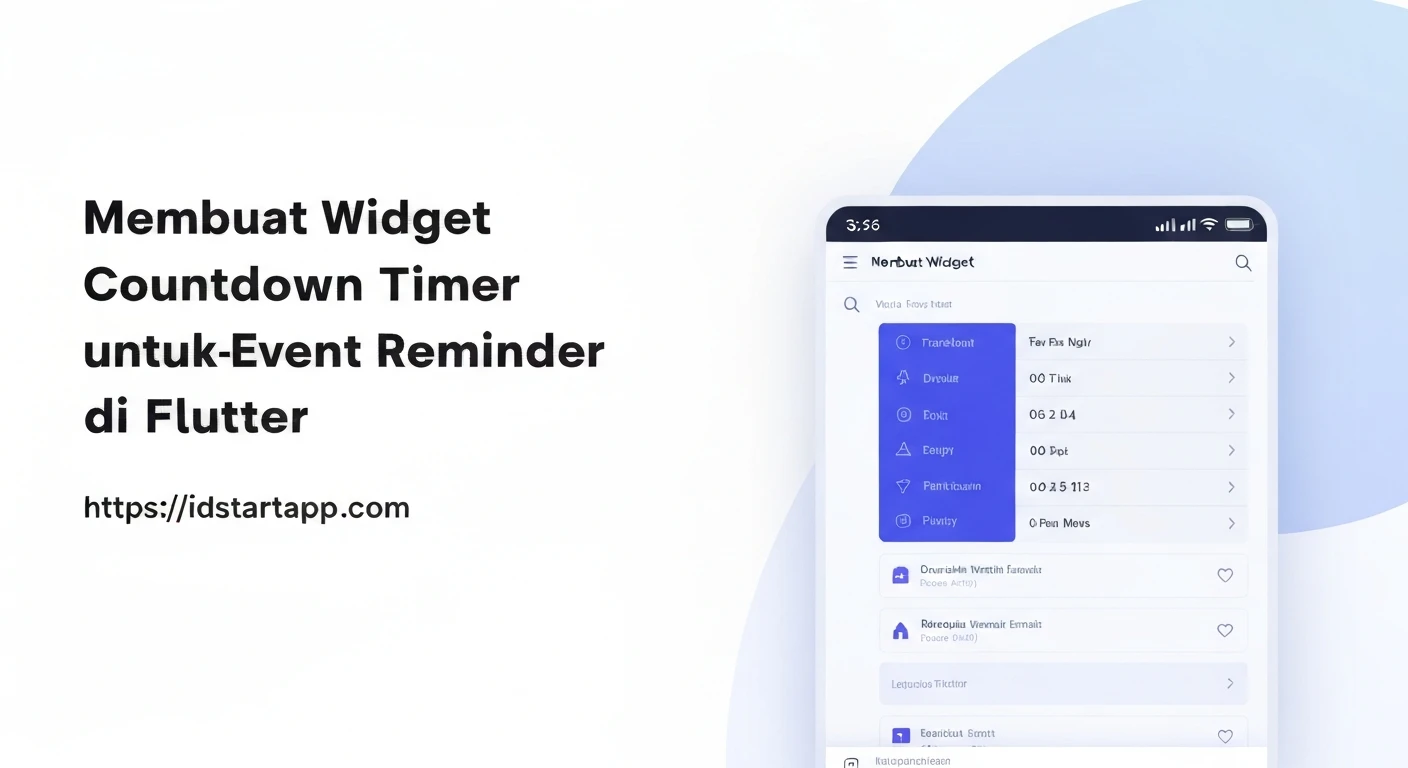

Creating a Countdown Timer Widget for Multi-Event Reminder in Flutter
Countdown timers are ubiquitous in modern applications, serving purposes from e-commerce sales to personal event reminders. In Flutter, building a robust and flexible countdown timer that can track multiple events simultaneously requires careful consideration of state management, data modeling, and UI updates. This article will guide you through the process of developing a "Multi-Event Countdown Timer" widget in Flutter, capable of reminding users about various upcoming occasions.
Understanding the Core Requirements
Before diving into the code, let's outline the essential features of our widget:
- Multi-Event Support: The ability to display countdowns for several distinct events.
- Real-time Updates: The countdown should refresh every second.
- Event Data Model: A structured way to represent each event (e.g., name, target date/time).
- Clear Display: Showing remaining time in a user-friendly format (days, hours, minutes, seconds).
- Handling Past Events: Gracefully managing events that have already occurred.
1. Defining the Event Data Model
To manage multiple events efficiently, we first need a data structure to hold information about each event. A simple Dart class will suffice.
class EventItem {
  final String name;
  final DateTime targetDateTime;
  final String description;

  EventItem({
    required this.name,
    required this.targetDateTime,
    this.description = '',
  });
}
This EventItem class provides fields for the event's name, its target date and time, and an optional description.
2. Building the Individual Countdown Logic
The heart of our solution is a widget that can calculate and display the time remaining until a specific DateTime. We'll use a StatefulWidget to manage the timer's state and trigger UI updates.
import 'dart:async';
import 'package:flutter/material.dart';

class CountdownTimer extends StatefulWidget {
  final EventItem event;
  final VoidCallback? onEventFinished;

  const CountdownTimer({
    Key? key,
    required this.event,
    this.onEventFinished,
  }) : super(key: key);

  @override
  _CountdownTimerState createState() => _CountdownTimerState();
}

class _CountdownTimerState extends State<CountdownTimer> {
  late Duration _timeRemaining;
  late Timer _timer;

  @override
  void initState() {
    super.initState();
    _calculateTimeRemaining();
    _timer = Timer.periodic(const Duration(seconds: 1), (timer) {
      setState(() {
        _calculateTimeRemaining();
        if (_timeRemaining.isNegative && timer.isActive) {
          _timer.cancel(); // Stop the timer once the event has passed
          widget.onEventFinished?.call();
        }
      });
    });
  }

  void _calculateTimeRemaining() {
    _timeRemaining = widget.event.targetDateTime.difference(DateTime.now());
  }

  @override
  void dispose() {
    _timer.cancel(); // Crucially, cancel the timer to prevent memory leaks
    super.dispose();
  }

  String _formatDuration(Duration duration) {
    if (duration.isNegative) {
      return 'Event has passed!';
    }
    String twoDigits(int n) => n.toString().padLeft(2, '0');
    String days = duration.inDays.toString();
    String hours = twoDigits(duration.inHours.remainder(24));
    String minutes = twoDigits(duration.inMinutes.remainder(60));
    String seconds = twoDigits(duration.inSeconds.remainder(60));
    return '${days}d ${hours}h ${minutes}m ${seconds}s';
  }

  @override
  Widget build(BuildContext context) {
    return Card(
      margin: const EdgeInsets.symmetric(vertical: 8.0, horizontal: 16.0),
      elevation: 4,
      shape: RoundedRectangleBorder(borderRadius: BorderRadius.circular(10)),
      child: Padding(
        padding: const EdgeInsets.all(16.0),
        child: Column(
          crossAxisAlignment: CrossAxisAlignment.start,
          children: [
            Text(
              widget.event.name,
              style: Theme.of(context).textTheme.headline6,
            ),
            if (widget.event.description.isNotEmpty)
              Padding(
                padding: const EdgeInsets.only(top: 4.0),
                child: Text(
                  widget.event.description,
                  style: Theme.of(context).textTheme.bodyText2?.copyWith(color: Colors.grey[600]),
                ),
              ),
            const SizedBox(height: 10),
            Text(
              _formatDuration(_timeRemaining),
              style: Theme.of(context).textTheme.headline5?.copyWith(
                    color: _timeRemaining.isNegative ? Colors.red.shade700 : Theme.of(context).primaryColor,
                    fontWeight: FontWeight.bold,
                  ),
            ),
          ],
        ),
      ),
    );
  }
}
Key aspects of this CountdownTimer widget:
_timer: An instance ofTimer.periodicthat triggers updates every second._timeRemaining: ADurationobject that stores the difference between the target time and the current time.initState: Initializes the timer and calculates the initial remaining time.dispose: Crucially, the timer is canceled here to prevent memory leaks when the widget is removed from the widget tree._formatDuration: A helper method to convert theDurationinto a human-readable string, also handling past events.
3. Implementing the Multi-Event Reminder List
Now, let's create a main widget that holds a list of EventItem objects and displays them using our CountdownTimer widget.
class MultiEventReminderScreen extends StatefulWidget {
  const MultiEventReminderScreen({Key? key}) : super(key: key);

  @override
  _MultiEventReminderScreenState createState() => _MultiEventReminderScreenState();
}

class _MultiEventReminderScreenState extends State<MultiEventReminderScreen> {
  final List<EventItem> _events = [
    EventItem(
      name: 'Flutter Widget Release',
      description: 'Exciting new widgets are coming!',
      targetDateTime: DateTime.now().add(const Duration(days: 7, hours: 10, minutes: 30)),
    ),
    EventItem(
      name: 'Project Deadline',
      description: 'Final submission for Project X',
      targetDateTime: DateTime.now().add(const Duration(hours: 2, minutes: 15, seconds: 45)),
    ),
    EventItem(
      name: 'Birthday Party',
      targetDateTime: DateTime.now().add(const Duration(days: 30)),
    ),
    EventItem(
      name: 'Meeting with Client',
      description: 'Review Q3 Performance',
      targetDateTime: DateTime.now().add(const Duration(minutes: 5)),
    ),
    EventItem(
      name: 'Past Event Example',
      description: 'This event has already happened.',
      targetDateTime: DateTime.now().subtract(const Duration(days: 1, hours: 5)),
    ),
    EventItem(
      name: 'Another Past Event',
      description: 'This was a long time ago.',
      targetDateTime: DateTime.now().subtract(const Duration(days: 10, hours: 3)),
    ),
  ];

  void _handleEventFinished(EventItem event) {
    // This callback is triggered when an event's countdown reaches zero.
    // Here, you could implement local notifications, remove the event,
    // or update its status in persistent storage.
    print('${event.name} has finished!');
    // For this example, we'll just log it. The CountdownTimer widget
    // itself will display "Event has passed!".
  }

  @override
  Widget build(BuildContext context) {
    // Sort events dynamically for a better user experience:
    // Upcoming events first (closest first), then past events (most recent first).
    _events.sort((a, b) {
      final now = DateTime.now();
      final aDiff = a.targetDateTime.difference(now);
      final bDiff = b.targetDateTime.difference(now);

      // Separate future events from past events
      if (aDiff.isNegative && !bDiff.isNegative) return 1; // 'a' is past, 'b' is future -> 'a' comes after 'b'
      if (!aDiff.isNegative && bDiff.isNegative) return -1; // 'a' is future, 'b' is past -> 'a' comes before 'b'

      // If both are future, sort by closest first
      if (!aDiff.isNegative && !bDiff.isNegative) {
        return a.targetDateTime.compareTo(b.targetDateTime);
      }

      // If both are past, sort by most recent first (descending targetDateTime)
      return b.targetDateTime.compareTo(a.targetDateTime);
    });

    return Scaffold(
      appBar: AppBar(
        title: const Text('Multi-Event Reminders'),
        centerTitle: true,
      ),
      body: ListView.builder(
        itemCount: _events.length,
        itemBuilder: (context, index) {
          final event = _events[index];
          return CountdownTimer(
            event: event,
            onEventFinished: () => _handleEventFinished(event),
          );
        },
      ),
    );
  }
}
In MultiEventReminderScreen:
_events: A list ofEventItemobjects, representing all events to be tracked.- Sorting: Events are sorted to display upcoming events first (closest first), followed by past events (most recent first). This improves user experience.
ListView.builder: Efficiently renders a potentially large list of countdown widgets._handleEventFinished: A callback that gets triggered when an individual event's countdown reaches zero or becomes negative. This is where you might integrate local notifications or other post-event actions.
Putting It All Together (main.dart)
To run this application, integrate the MultiEventReminderScreen into your main.dart file.
import 'package:flutter/material.dart';
// Assuming EventItem and both widgets are in the same file or properly imported
// If you separated them into different files, e.g., 'widgets/countdown_widgets.dart',
// you would import them like:
// import 'package:your_app_name/widgets/countdown_widgets.dart';

void main() {
  runApp(const MyApp());
}

class MyApp extends StatelessWidget {
  const MyApp({Key? key}) : super(key: key);

  @override
  Widget build(BuildContext context) {
    return MaterialApp(
      title: 'Multi-Event Countdown',
      theme: ThemeData(
        primarySwatch: Colors.teal,
        visualDensity: VisualDensity.adaptivePlatformDensity,
        appBarTheme: const AppBarTheme(
          backgroundColor: Colors.teal,
          foregroundColor: Colors.white,
        ),
      ),
      home: const MultiEventReminderScreen(),
    );
  }
}
Further Enhancements and Considerations
- Persistent Storage: For a real-world application, events should be stored persistently using solutions like
shared_preferences,sqflite, or a cloud database (Firebase, Supabase) to ensure data isn't lost when the app closes. - Local Notifications: Integrate packages like
flutter_local_notificationsto send timely reminders when an event is approaching or has started, even if the app is in the background. - Advanced State Management: For larger applications, consider using Provider, Riverpod, BLoC, or GetX for more scalable state management. This would allow you to manage events from a central store, making it easier to add, edit, or delete events and react to changes across different parts of your app.
- UI Customization: Allow users to customize the appearance of countdown timers (e.g., colors, fonts, layout) or add different themes.
- Event Management: Implement functionality to add new events, edit existing ones, and delete events from the list. This would typically involve navigating to a dedicated form screen.
- Localization: Translate the "Event has passed!" message and ensure date/time formats are appropriate for international users.
- Background Tasks: For very critical reminders, explore Flutter's capabilities for running code in the background (e.g., with
workmanager) to ensure notifications are delivered precisely on time, even if the app is terminated.
Conclusion
Building a multi-event countdown timer in Flutter is a practical exercise that combines several core Flutter concepts: state management with StatefulWidget, timer handling with dart:async, and dynamic list rendering with ListView.builder. By following the steps outlined in this article, you can create a robust and user-friendly reminder system, ready to be expanded with more advanced features. This foundational widget serves as an excellent starting point for various time-sensitive applications.