
Building a Multi-Event Countdown Timer Widget in Flutter
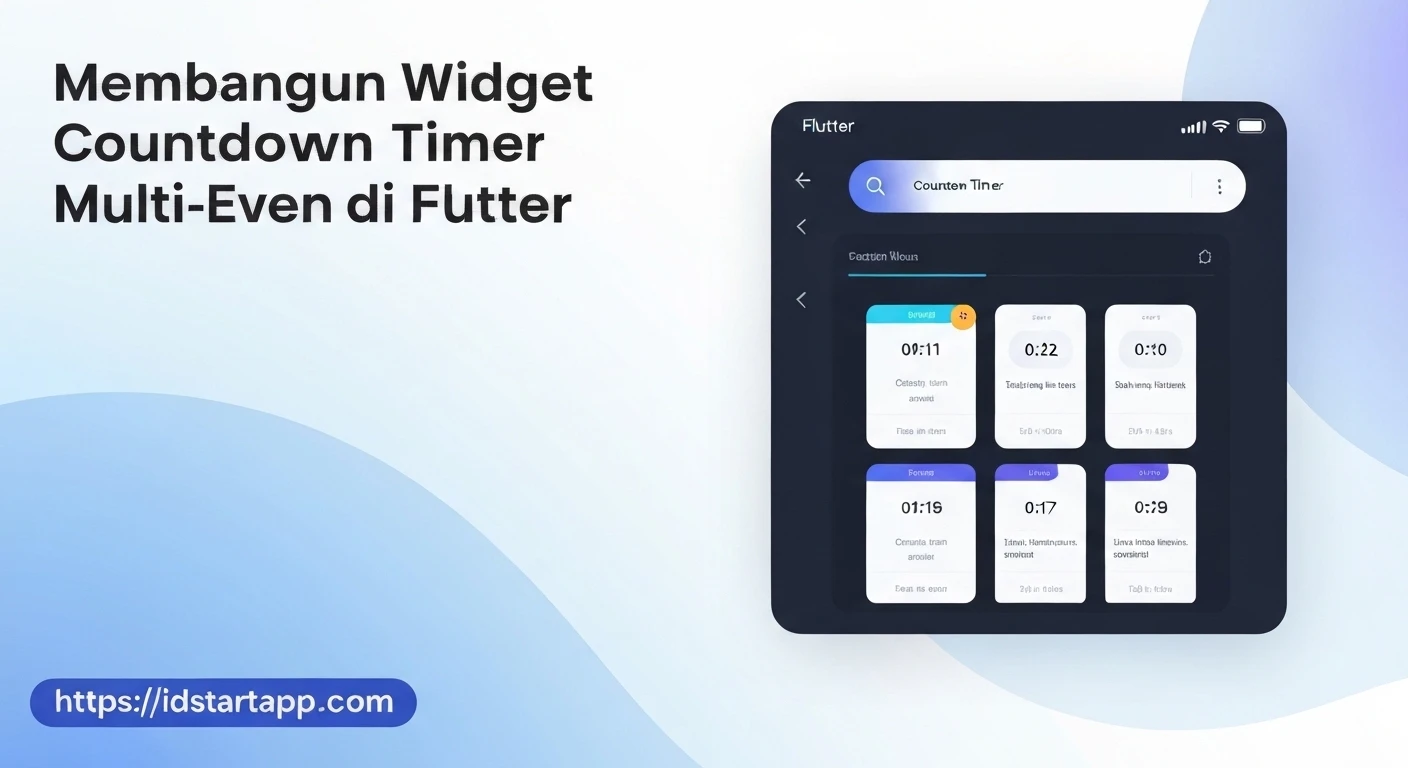
Countdown timers are a ubiquitous feature in modern applications, used for everything from e-commerce sales to event reminders. While a single-event countdown is straightforward, building a multi-event timer that can concurrently track several upcoming deadlines presents a unique set of challenges and opportunities for robust design. This article will guide you through creating a versatile multi-event countdown timer widget in Flutter, focusing on clean architecture, efficient state management, and an intuitive user experience.
Core Concepts
Before diving into the implementation, let's establish the fundamental concepts required:
- Event Model: A clear data structure to represent each event, including its name and target date/time.
- State Management: Efficiently updating the UI as time progresses for multiple independent events.
- Timer Mechanism: Utilizing Flutter's
Timerclass to periodically update countdown values. - Time Calculation: Accurately determining remaining time (days, hours, minutes, seconds) until each event.
Step-by-Step Implementation
1. Defining the Event Model
First, we need a simple class to encapsulate the details of each event. This class will hold the event's title and its target DateTime.
import 'package:flutter/foundation.dart'; // For @required if not nullable

class CountdownEvent {
  final String title;
  final DateTime targetDateTime;

  CountdownEvent({
    required this.title,
    required this.targetDateTime,
  });

  Duration get timeRemaining {
    return targetDateTime.difference(DateTime.now());
  }
}
2. Creating a Multi-Event Countdown Manager
To manage multiple events and their respective countdowns, we'll create a ChangeNotifier class. This manager will hold a list of CountdownEvent objects and periodically update them. Widgets listening to this manager will rebuild when notifyListeners() is called.
import 'dart:async';
import 'package:flutter/material.dart';

// Assuming CountdownEvent is defined as above

class CountdownManager extends ChangeNotifier {
  List _events = [];
  Timer? _timer;

  List get events => _events;

  CountdownManager() {
    // Initialize with some dummy events for demonstration
    _events = [
      CountdownEvent(
        title: 'Project Deadline',
        targetDateTime: DateTime.now().add(const Duration(days: 3, hours: 10, minutes: 30, seconds: 15)),
      ),
      CountdownEvent(
        title: 'Launch Event',
        targetDateTime: DateTime.now().add(const Duration(days: 10, hours: 2, minutes: 0, seconds: 0)),
      ),
      CountdownEvent(
        title: 'Holiday Break',
        targetDateTime: DateTime.now().add(const Duration(days: 30, hours: 23, minutes: 59, seconds: 59)),
      ),
      CountdownEvent(
        title: 'Past Event (will show 0)',
        targetDateTime: DateTime.now().subtract(const Duration(hours: 1)),
      ),
    ];
    _startTimer();
  }

  void addEvent(CountdownEvent event) {
    _events.add(event);
    _events.sort((a, b) => a.targetDateTime.compareTo(b.targetDateTime)); // Keep sorted
    notifyListeners();
  }

  void removeEvent(CountdownEvent event) {
    _events.remove(event);
    notifyListeners();
  }

  void _startTimer() {
    _timer = Timer.periodic(const Duration(seconds: 1), (timer) {
      // Re-calculate remaining time for all events
      // No need to modify events list, just notify listeners
      // to re-read the timeRemaining getter from each event.
      notifyListeners();
    });
  }

  @override
  void dispose() {
    _timer?.cancel();
    super.dispose();
  }
}
3. Building the Countdown Display Widget
Now, let's create a widget responsible for displaying a single countdown. This widget will take a CountdownEvent and render its remaining time. We'll make it stateless and let the CountdownManager drive its updates via Provider or Consumer.
import 'package:flutter/material.dart';

// Assuming CountdownEvent is defined

class CountdownDisplay extends StatelessWidget {
  final CountdownEvent event;

  const CountdownDisplay({Key? key, required this.event}) : super(key: key);

  String _formatDuration(Duration duration) {
    if (duration.isNegative) {
      return 'Event Passed!';
    }
    String twoDigits(int n) => n.toString().padLeft(2, '0');
    String days = duration.inDays.toString();
    String hours = twoDigits(duration.inHours.remainder(24));
    String minutes = twoDigits(duration.inMinutes.remainder(60));
    String seconds = twoDigits(duration.inSeconds.remainder(60));

    return '${days}d ${hours}h ${minutes}m ${seconds}s';
  }

  @override
  Widget build(BuildContext context) {
    return Padding(
      padding: const EdgeInsets.symmetric(vertical: 8.0, horizontal: 16.0),
      child: Card(
        elevation: 3,
        child: Padding(
          padding: const EdgeInsets.all(16.0),
          child: Column(
            crossAxisAlignment: CrossAxisAlignment.start,
            children: [
              Text(
                event.title,
                style: const TextStyle(fontSize: 20, fontWeight: FontWeight.bold),
              ),
              const SizedBox(height: 8),
              Text(
                _formatDuration(event.timeRemaining),
                style: const TextStyle(fontSize: 24, color: Colors.blueAccent),
              ),
              const SizedBox(height: 8),
              Text(
                'Target: ${event.targetDateTime.toLocal().toString().split('.')[0]}',
                style: const TextStyle(fontSize: 14, color: Colors.grey),
              ),
            ],
          ),
        ),
      ),
    );
  }
}
4. Integrating with the UI (using Provider)
To connect our CountdownManager to the UI, we'll use the provider package, which is a popular and efficient way to manage state in Flutter.
First, add provider to your pubspec.yaml:
dependencies:
  flutter:
    sdk: flutter
  provider: ^6.0.5 # Use the latest version
Then, wrap your application or a specific part of your widget tree with ChangeNotifierProvider to make the CountdownManager accessible.
import 'package:flutter/material.dart';
import 'package:provider/provider.dart';
// Assuming CountdownManager and CountdownDisplay are defined

void main() {
  runApp(const MyApp());
}

class MyApp extends StatelessWidget {
  const MyApp({Key? key}) : super(key: key);

  @override
  Widget build(BuildContext context) {
    return MultiProvider(
      providers: [
        ChangeNotifierProvider(create: (_) => CountdownManager()),
      ],
      child: MaterialApp(
        title: 'Multi-Event Countdown',
        theme: ThemeData(
          primarySwatch: Colors.blue,
          visualDensity: VisualDensity.adaptivePlatformDensity,
        ),
        home: const CountdownHomePage(),
      ),
    );
  }
}

class CountdownHomePage extends StatelessWidget {
  const CountdownHomePage({Key? key}) : super(key: key);

  @override
  Widget build(BuildContext context) {
    // Watch for changes in CountdownManager to rebuild the list
    final countdownManager = context.watch();

    return Scaffold(
      appBar: AppBar(
        title: const Text('Multi-Event Countdown Timer'),
      ),
      body: countdownManager.events.isEmpty
          ? const Center(child: Text('No countdown events configured.'))
          : ListView.builder(
              itemCount: countdownManager.events.length,
              itemBuilder: (context, index) {
                final event = countdownManager.events[index];
                return CountdownDisplay(event: event);
              },
            ),
      floatingActionButton: FloatingActionButton(
        onPressed: () {
          // Example of adding a new event dynamically
          countdownManager.addEvent(
            CountdownEvent(
              title: 'New Dynamic Event',
              targetDateTime: DateTime.now().add(const Duration(minutes: 5, seconds: 30)),
            ),
          );
        },
        child: const Icon(Icons.add),
      ),
    );
  }
}
Enhancements and Considerations
- Sorting: Ensure events are always sorted by their target date/time for better presentation. Our
addEventmethod already includes this. - Handling Past Events: Decide how to display events that have already passed (e.g., "Event Passed!", hide them, or move to a separate section). Our current
_formatDurationshows "Event Passed!". - Localization: For a global audience, consider localizing date/time formats and duration strings.
- Performance for Many Events: For a very large number of events, optimizing
notifyListeners()calls or only updating visible items might be necessary, thoughListView.builderalready handles UI virtualization. - Background Execution: If countdowns need to run and notify the user when the app is in the background, platform-specific background tasks (e.g., WorkManager for Android, background fetch for iOS) would be required, which is beyond the scope of a basic Flutter widget.
- User Interaction: Add functionality to edit or delete events, or to add new events via a form.
Conclusion
Building a multi-event countdown timer in Flutter involves careful consideration of data modeling, state management, and efficient UI updates. By leveraging ChangeNotifier and Provider, combined with a well-defined CountdownEvent model and a dedicated CountdownDisplay widget, we can create a scalable and maintainable solution. This approach provides a solid foundation that can be extended with more advanced features and tailored to specific application requirements.