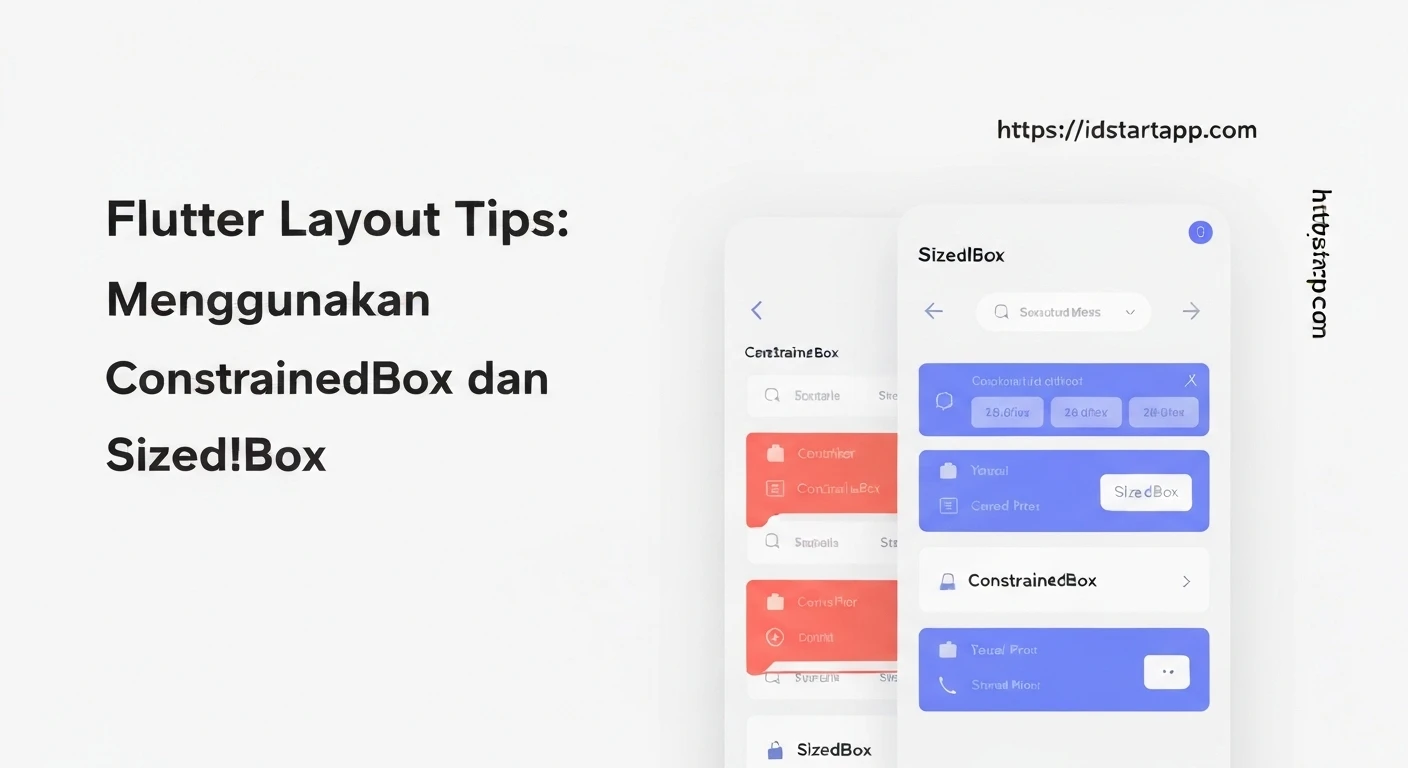

Flutter Layout Tips: Mastering ConstrainedBox and SizedBox
Flutter's declarative UI relies heavily on an efficient and intuitive layout system. At its core, understanding how widgets are sized and positioned involves grasping the concept of "constraints." Two fundamental widgets that play a crucial role in controlling widget dimensions are ConstrainedBox and SizedBox. While they both deal with size, their purposes and how they interact with the layout tree differ significantly. This article will delve into each, providing insights into their proper usage and practical tips.
Understanding Flutter's Constraint System
Before diving into specific widgets, it's essential to briefly recap Flutter's layout philosophy:
- A parent passes constraints down to its child. Constraints define the minimum and maximum width and height the child can have.
- The child then decides its own size within those constraints.
- The parent then positions the child.
This "parent constrains child" model is crucial. Widgets don't have absolute sizes; they try to fit within the constraints provided by their parent. ConstrainedBox and SizedBox allow us to manipulate these constraints or directly specify a child's size within the constraints.
SizedBox: For Fixed Dimensions and Spacing
The SizedBox widget is perhaps one of the most frequently used layout widgets. Its primary purpose is to give its child a specific, fixed width or height, or to create empty space with defined dimensions.
When to use SizedBox:
- Fixed Dimensions: When you need a widget to be exactly a certain width or height, regardless of its child's intrinsic size or other parent constraints (as long as it fits within them).
- Adding Space: To create gaps or padding between widgets, especially in
RoworColumnlayouts. This is a common and highly readable alternative to usingPaddingfor simple spacing.
Example Usage:
Row(
  children: <Widget>[
    Container(color: Colors.red, width: 50, height: 50),
    // Add 20 pixels of horizontal space
    SizedBox(width: 20),
    Container(color: Colors.blue, width: 50, height: 50),
    // Make the child exactly 100x100
    SizedBox(
      width: 100,
      height: 100,
      child: Container(color: Colors.green),
    ),
  ],
)
Key Characteristics:
SizedBoxattempts to force its child to its specified dimensions.- If the parent's constraints are tighter than the
SizedBox's requested size (e.g., parent says max width is 50, butSizedBoxwants 100), theSizedBoxwill obey the parent's tighter constraints. - It can also be used without a child (
SizedBox(width: 20)) to effectively create empty space.
ConstrainedBox: For Minimum and Maximum Constraints
The ConstrainedBox widget applies additional constraints on its child, often modifying the constraints passed down by its own parent. It takes a BoxConstraints object, allowing you to specify minimum and maximum widths and heights.
When to use ConstrainedBox:
- Minimum Size Requirements: To ensure a widget is at least a certain size, which is crucial for touch targets (e.g., a button should be at least 48x48 pixels for easy tapping).
- Maximum Size Limits: To prevent a widget from growing indefinitely, especially in flexible layouts where it might otherwise expand to fill all available space.
- Responsive Design: To control the range of sizes a widget can occupy in varying screen sizes.
Example Usage:
Column(
  children: <Widget>[
    // Ensure the button is at least 48x48
    ConstrainedBox(
      constraints: BoxConstraints(minWidth: 48, minHeight: 48),
      child: ElevatedButton(
        onPressed: () {},
        child: Text('Tap Me'),
      ),
    ),
    SizedBox(height: 20),
    // Limit the maximum width of a text field
    ConstrainedBox(
      constraints: BoxConstraints(maxWidth: 300),
      child: TextField(
        decoration: InputDecoration(
          border: OutlineInputBorder(),
          labelText: 'Your Name',
        ),
      ),
    ),
  ],
)
Key Characteristics:
ConstrainedBox"intercepts" the constraints from its parent and then applies an intersection of its ownBoxConstraintswith the parent's constraints before passing them to its child.- For example, if the parent says "minWidth: 0, maxWidth: infinity" and
ConstrainedBoxsays "minWidth: 100, maxWidth: 200", the child will receive "minWidth: 100, maxWidth: 200". - If the parent says "minWidth: 50, maxWidth: 150" and
ConstrainedBoxsays "minWidth: 100, maxWidth: 200", the child will receive "minWidth: 100" (max of 50 and 100) and "maxWidth: 150" (min of 150 and 200).
SizedBox vs. ConstrainedBox: Choosing the Right Tool
The choice between SizedBox and ConstrainedBox depends on your intent:
- Use
SizedBoxwhen you want to make a widget exactly a certain size (e.g., a 100x100 square) or to create a fixed amount of empty space. It's direct and absolute (within parent constraints). - Use
ConstrainedBoxwhen you want to define a range of acceptable sizes (e.g., "at least 50px wide, but no more than 200px wide") or to guarantee a minimum interactive area. It's about setting boundaries, not absolute dimensions.
A common pitfall is trying to use SizedBox to enforce a minimum size. While it can work if the child inherently tries to be smaller, ConstrainedBox is the semantically correct and more robust solution for minimums and maximums because it works by modifying the constraints themselves.
Practical Tips and Best Practices
- Combine for Flexibility: You can combine these widgets. For instance, a
ConstrainedBoxto set min/max, containing aSizedBoxthat tries to achieve a preferred size within those limits. - Padding for Internal Spacing, SizedBox for External: Use
Paddingto add space *around* the content of a single widget. UseSizedBoxto add space *between* separate widgets in aRoworColumn. This improves readability. - Understanding Expanded/Flexible: Remember that widgets like
ExpandedandFlexibleinRow/Columnalso manage constraints, often providing infinite constraints in one direction.ConstrainedBoxis particularly useful here to prevent children from becoming excessively large. - Debug with Caution: Layout issues can be tricky. When facing an "overflow" error, trace the constraints from parent to child to understand where the widget is receiving unexpected constraints.
Conclusion
ConstrainedBox and SizedBox are powerful and frequently used tools in Flutter's layout toolkit. By understanding their distinct roles—SizedBox for fixed dimensions and spacing, and ConstrainedBox for setting minimum and maximum size boundaries—developers can gain finer control over their UI, leading to more robust, responsive, and visually appealing applications. Master these two, and you'll be well on your way to a deeper understanding of Flutter's layout system.