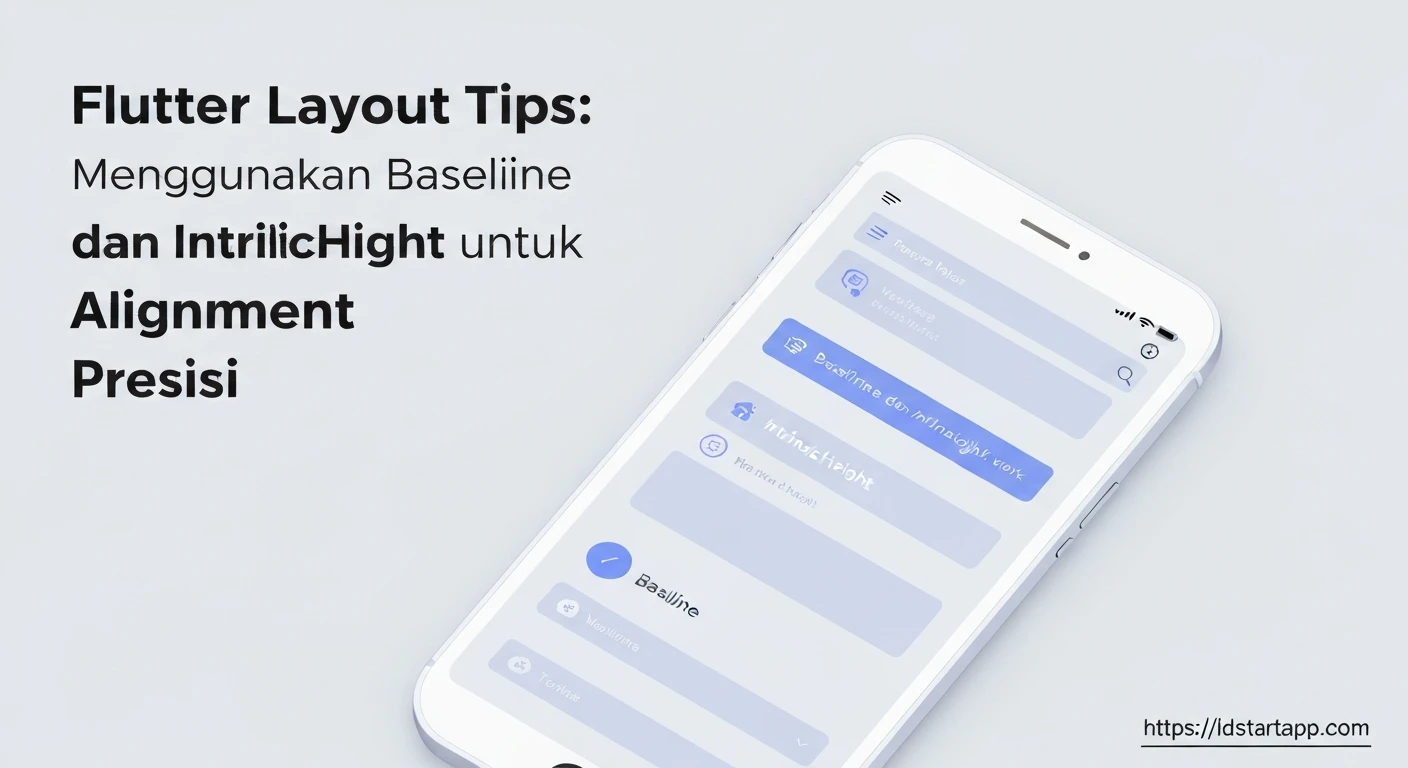

Flutter Layout Tips: Leveraging Baseline and IntrinsicHeight for Precise Alignment
Achieving pixel-perfect alignment in Flutter layouts can sometimes be challenging, especially when dealing with dynamic content, varying text sizes, or widgets that don't naturally align. While Flutter's declarative layout system is incredibly powerful, specific scenarios demand more specialized tools. This article explores two such tools: the Baseline widget and the IntrinsicHeight widget, demonstrating how they can be used to gain precise control over your UI's alignment and sizing.
Using Baseline for Text Alignment
The concept of a "baseline" is fundamental in typography, referring to the invisible line upon which most letters sit. When mixing text of different font sizes or aligning text with non-text elements (like icons), simply relying on vertical center alignment often leads to an aesthetically unpleasing result, as the visual "center" of a letter can differ from its true baseline.
Flutter's Baseline widget allows you to explicitly define a baseline for its child, relative to the top of the Baseline widget itself. This is particularly useful when you need to align multiple widgets along a common horizontal line that isn't their natural top, bottom, or center.
Consider a scenario where you want to align a small piece of text with a larger piece of text, ensuring their baselines match, even if they are wrapped in containers with different padding. The parent Row can then use crossAxisAlignment: CrossAxisAlignment.baseline to align these declared baselines.
Row(
  crossAxisAlignment: CrossAxisAlignment.baseline,
  textBaseline: TextBaseline.alphabetic, // Required when crossAxisAlignment is baseline
  children: [
    Baseline(
      baseline: 50.0, // The baseline relative to the top of this widget
      baselineType: TextBaseline.alphabetic,
      child: Container(
        padding: EdgeInsets.all(8),
        color: Colors.red.withOpacity(0.2),
        child: Text(
          'Small Text',
          style: TextStyle(fontSize: 16, color: Colors.black),
        ),
      ),
    ),
    Baseline(
      baseline: 80.0, // A different baseline value to achieve alignment
      baselineType: TextBaseline.alphabetic,
      child: Container(
        padding: EdgeInsets.all(16),
        color: Colors.blue.withOpacity(0.2),
        child: Text(
          'Large Text',
          style: TextStyle(fontSize: 32, color: Colors.black),
        ),
      ),
    ),
    Icon(
      Icons.star,
      size: 40,
      color: Colors.green,
    ),
  ],
)
In this example, each Baseline widget declares its child's baseline at a specific vertical offset (baseline property) from its own top edge. The Row then aligns these declared baselines. Note that the Icon widget, when placed in a Row with crossAxisAlignment: CrossAxisAlignment.baseline, will align its logical baseline (often its bottom edge for icons) with the text baselines. This provides much finer control than simple center alignment, especially for mixed content.
Harnessing IntrinsicHeight for Dynamic Sizing
Flutter's layout system typically performs a single pass: parents pass constraints down to children, and children pass their sizes back up. This efficient process means that a parent usually doesn't know its children's exact sizes before they are laid out. However, there are cases where you need a parent to size itself based on the "intrinsic" height of its children, specifically when you want siblings in a Row or Column to match the height of the tallest child.
The IntrinsicHeight widget computes the intrinsic height of its child, which is the height the child would like to be if it were given infinite width. This allows a parent to size its height based on the maximum height of its children. This is particularly useful for achieving "equal height columns" where content might vary.
It's important to note that IntrinsicHeight is computationally expensive. It forces its child to perform an extra layout pass to determine its intrinsic height, breaking Flutter's usual single-pass layout model. Therefore, it should be used judiciously and only when other, more performant layout widgets (like Expanded, Flexible, or explicit SizedBox) cannot achieve the desired effect.
Here's an example where we want two columns in a Row to always have the same height, dictated by the tallest column:
IntrinsicHeight(
  child: Row(
    crossAxisAlignment: CrossAxisAlignment.stretch, // Important: makes children fill the intrinsic height
    children: [
      Expanded(
        child: Container(
          padding: EdgeInsets.all(16),
          color: Colors.red.withOpacity(0.2),
          child: Column(
            children: [
              Text('Short Title'),
              SizedBox(height: 8),
              Text(
                'This column has relatively less content, but thanks to IntrinsicHeight, it will match the height of its taller sibling.',
                textAlign: TextAlign.center,
              ),
            ],
          ),
        ),
      ),
      Expanded(
        child: Container(
          padding: EdgeInsets.all(16),
          color: Colors.blue.withOpacity(0.2),
          child: Column(
            children: [
              Text('Longer Content Column Example'),
              SizedBox(height: 8),
              Text(
                'This column contains a significantly larger amount of text that will likely wrap multiple lines and increase its height. IntrinsicHeight ensures that the adjacent column will stretch to match this height, creating a balanced visual layout.',
                textAlign: TextAlign.center,
              ),
              SizedBox(height: 8),
              Text('Additional detail here.'),
            ],
          ),
        ),
      ),
    ],
  ),
)
In this code, IntrinsicHeight wraps the Row. The Row's crossAxisAlignment: CrossAxisAlignment.stretch ensures that its children (the Expanded containers) stretch to fill the height calculated by IntrinsicHeight. Without IntrinsicHeight, each Expanded child would only take the height required by its own content, leading to unequal column heights.
Conclusion
Baseline and IntrinsicHeight are powerful, albeit specialized, widgets for achieving precise layout control in Flutter. Baseline is invaluable for fine-tuning text and icon alignment, ensuring visual harmony across different font sizes and element types. IntrinsicHeight provides a solution for dynamic height matching among siblings, allowing for aesthetically pleasing "equal height" layouts where content varies. Remember to use IntrinsicHeight sparingly due to its performance implications, always favoring simpler layout approaches first. By understanding and strategically applying these widgets, you can craft more refined and professional-looking Flutter UIs.