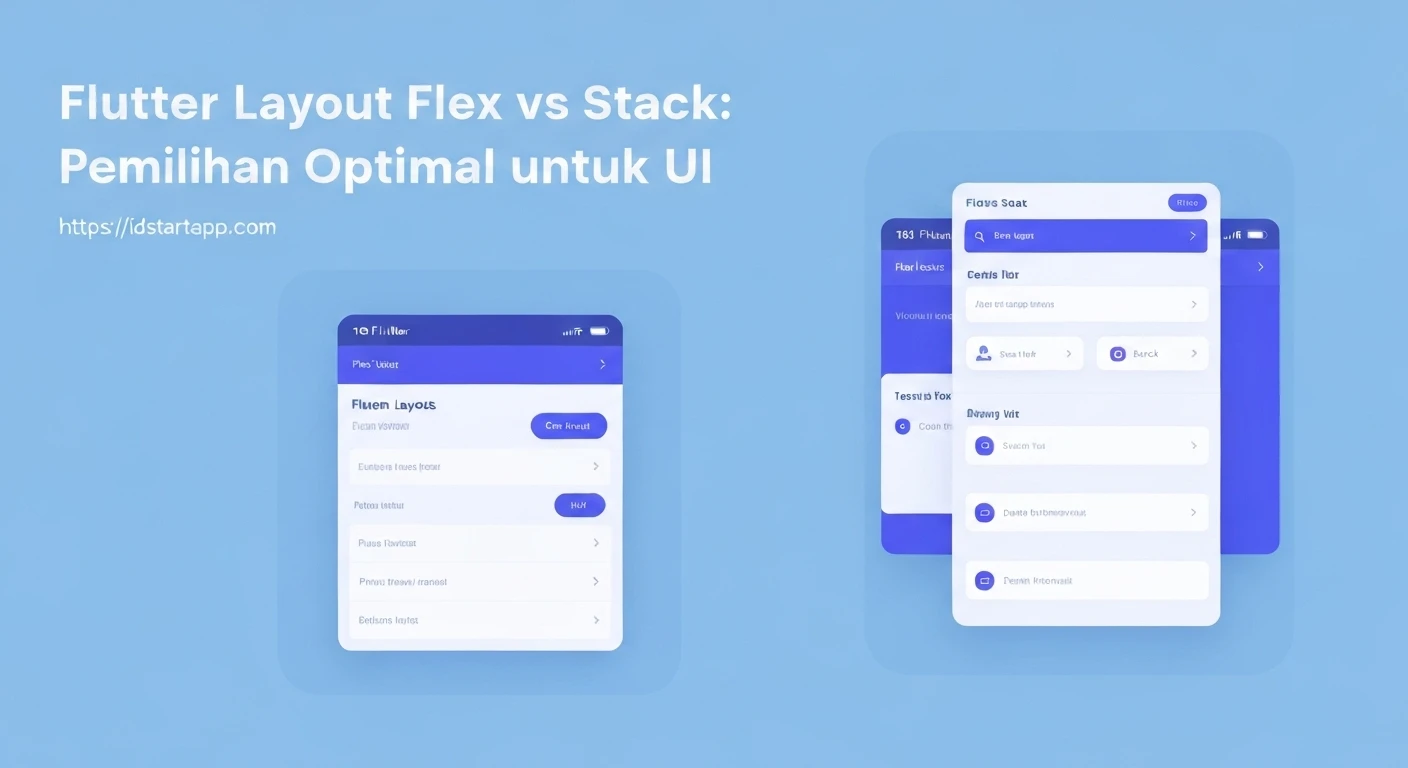

Flutter Layout Flex vs Stack: Optimal Choice for UI
Flutter offers a rich set of layout widgets to build compelling and responsive user interfaces. Among the fundamental building blocks, Flex (represented by Row and Column) and Stack are crucial for arranging widgets. Understanding their distinct purposes and optimal use cases is key to developing efficient and maintainable Flutter applications.
Understanding Flex Layout (Row and Column)
The Flex widget, primarily used through its specialized versions Row and Column, is designed for one-dimensional layouts. It arranges its children in a linear fashion, either horizontally (Row) or vertically (Column).
mainAxisAlignment: Controls how children are positioned along the main axis (e.g.,start,center,end,spaceBetween,spaceAround,spaceEvenly).crossAxisAlignment: Controls how children are positioned along the cross axis (perpendicular to the main axis) (e.g.,start,center,end,stretch,baseline).mainAxisSize: Determines how much space theRoworColumnshould occupy along its main axis (MainAxisSize.maxorMainAxisSize.min).
Use Row and Column when you need to arrange widgets sequentially. Common scenarios include:
- Lists of items (e.g., a list of products, chat messages).
- Forms with input fields and labels.
- Navigation bars or toolbars.
- Arranging elements side-by-side or stacked vertically.
Row(
  mainAxisAlignment: MainAxisAlignment.spaceEvenly,
  children: <Widget>[
    Icon(Icons.star),
    Text('Rating 4.5'),
    Icon(Icons.thumb_up),
  ],
)
Understanding Stack Layout
The Stack widget, on the other hand, is designed for arranging widgets on top of each other, in a Z-axis fashion. It allows children to overlap, with the last child in the list being painted on top.
alignment: Controls how non-Positionedchildren are aligned within theStack(e.g.,Alignment.center,Alignment.topLeft).fit: Determines how the non-Positionedchildren are constrained (StackFit.looseorStackFit.expand).Positionedwidget: Often used withStack, this widget wraps a child to give it explicit control over its position (e.g.,top,bottom,left,right,width,height).
Use Stack when you need to layer widgets, create overlays, or achieve complex visual compositions. Common scenarios include:
- Adding a badge or an icon on top of an image.
- Creating custom shapes or background effects.
- Displaying loading indicators or pop-up menus over existing content.
- Overlaying text or other elements on a background image.
Stack(
  alignment: Alignment.center,
  children: <Widget>[
    Container(
      width: 150,
      height: 150,
      color: Colors.blue,
    ),
    Positioned(
      bottom: 10,
      right: 10,
      child: Text(
        'Overlay',
        style: TextStyle(color: Colors.white, fontSize: 20),
      ),
    ),
  ],
)
Flex vs. Stack: Making the Optimal Choice
Choosing between Flex and Stack depends entirely on the spatial relationship you want to establish between your widgets. Here's a comparison to guide your decision:
- Arrangement Logic:
Flexfor linear (side-by-side or one above another);Stackfor overlapping (one on top of another). - Dimensionality:
Flexis one-dimensional;Stackis essentially two-dimensional in terms of positioning within its bounds, plus a third dimension for layering. - Complexity: For simple linear arrangements,
Flexis straightforward. For complex layering with precise positioning,Stackcombined withPositionedis powerful but can become complex if not managed well. - Responsiveness:
Flexwidgets inherently adapt well to different screen sizes due to their content-driven sizing and alignment properties.StackwithPositionedwidgets requires more careful consideration for responsiveness, often needing dynamic calculations or responsive positioning. - Performance: Both are highly optimized. However, a large number of overlapping
Positionedwidgets in aStackmight require more layout passes than a simpleRoworColumn, but typically this is negligible for most UIs.
Optimal Selection Strategy
The optimal UI often involves a combination of both Flex and Stack:
- For Primary Layout: Start with
RoworColumnfor the main structural layout of your screen (e.g., aColumnholding a header, content area, and a footer). - For Component-Level Layout: Use
RowandColumnto arrange elements within smaller components (e.g., aRowfor an icon and text, aColumnfor stacked form fields). - For Overlays and Layering: Employ
Stackwhen you need elements to sit on top of others (e.g., a badge on an avatar, a floating action button over content, a gradient overlay on an image). - Nested Layouts: It's common and encouraged to nest these widgets. For instance, a
Columnmight contain aRow, which in turn contains aStack.
Conclusion
Flex (Row and Column) and Stack are fundamental and distinct layout widgets in Flutter, each serving a specific purpose. Flex is your go-to for linear arrangements, while Stack excels at creating layered and overlapping UIs. By understanding their strengths and combining them judiciously, developers can construct highly flexible, visually rich, and performant user interfaces that cater to diverse design requirements.