
Building an Interactive FAQ Accordion Widget in Flutter
Introduction
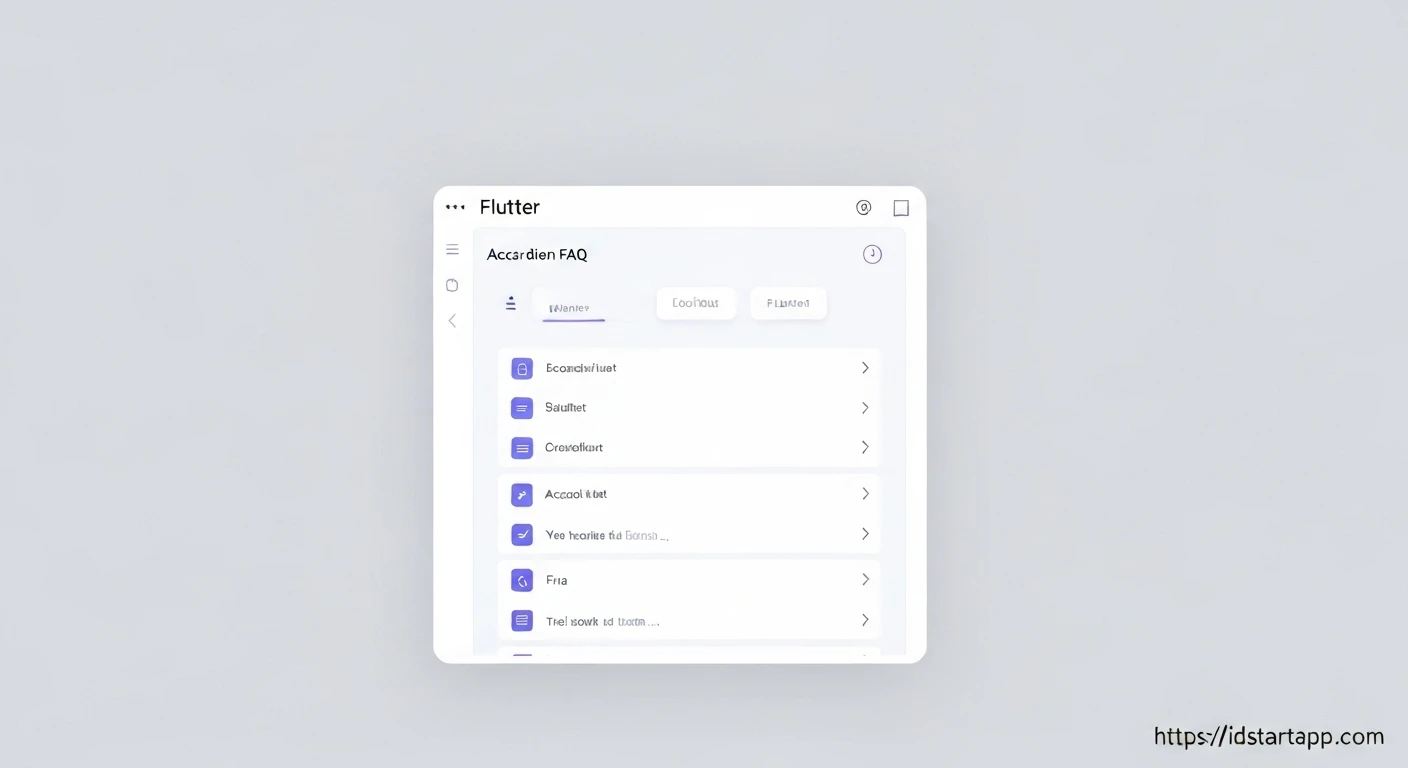
In modern application design, presenting information clearly and efficiently is paramount for a positive user experience. Frequently Asked Questions (FAQs) sections are common, but a long list of questions and answers can overwhelm users. An interactive FAQ accordion widget elegantly solves this by allowing users to expand only the information they need, saving screen real estate and improving navigation.
Flutter, with its declarative UI and powerful animation capabilities, is an excellent framework for building such interactive widgets. This article will guide you through creating a professional and animated FAQ accordion widget in Flutter, demonstrating core concepts like state management and explicit animations.
Understanding the Accordion Concept
An accordion widget typically consists of a list of items, each with a header (the question) and a collapsible body (the answer). Tapping the header toggles the visibility of its corresponding body. For a delightful user experience, these transitions should be smooth and animated, rather than abrupt.
Key Flutter concepts we'll utilize include:
- StatefulWidget: To manage the expanded/collapsed state of each FAQ item.
- Animations: For smooth transitions when an item expands or collapses, and for rotating icons.
- Layout Widgets: Such as `Column`, `ListTile`, and `Card` to structure the UI.
Defining the FAQ Data Model
First, let's create a simple Dart class to represent our FAQ data. This makes it easy to manage and display your questions and answers.
class FAQ {
  final String question;
  final String answer;

  FAQ({required this.question, required this.answer});
}
Creating the FAQ Item Widget
Each FAQ item will be a custom `StatefulWidget` to manage its own expansion state and animations. We will use `ListTile` for the question and an icon, `SizeTransition` for animating the answer's height, and `RotationTransition` for the expand/collapse icon.
import 'package:flutter/material.dart';

// Assuming the FAQ class is defined elsewhere or in the same file
class FAQ {
  final String question;
  final String answer;

  FAQ({required this.question, required this.answer});
}

class FAQItem extends StatefulWidget {
  final String question;
  final String answer;

  FAQItem({required this.question, required this.answer});

  @override
  _FAQItemState createState() => _FAQItemState();
}

class _FAQItemState extends State with SingleTickerProviderStateMixin {
  bool _isExpanded = false;
  late AnimationController _controller;
  late Animation _animation;

  @override
  void initState() {
    super.initState();
    _controller = AnimationController(
      vsync: this,
      duration: const Duration(milliseconds: 300), // Animation duration
    );
    _animation = CurvedAnimation(
      parent: _controller,
      curve: Curves.easeInOut, // Smooth animation curve
    );
  }

  @override
  void dispose() {
    _controller.dispose();
    super.dispose();
  }

  void _toggleExpand() {
    setState(() {
      _isExpanded = !_isExpanded;
      if (_isExpanded) {
        _controller.forward(); // Start expansion animation
      } else {
        _controller.reverse(); // Start collapse animation
      }
    });
  }

  @override
  Widget build(BuildContext context) {
    return Card(
      margin: const EdgeInsets.symmetric(vertical: 8.0),
      elevation: 2,
      child: Column(
        children: [
          ListTile(
            title: Text(
              widget.question,
              style: const TextStyle(
                fontWeight: FontWeight.bold,
                fontSize: 16.0,
              ),
            ),
            trailing: RotationTransition(
              turns: Tween(begin: 0.0, end: 0.5).animate(_animation), // Rotate icon 180 degrees
              child: const Icon(Icons.expand_more, color: Colors.grey),
            ),
            onTap: _toggleExpand, // Toggle expansion on tap
            contentPadding: const EdgeInsets.symmetric(horizontal: 16.0, vertical: 8.0),
          ),
          SizeTransition(
            sizeFactor: _animation, // Drives the height animation
            axisAlignment: 1.0, // Align content to the bottom during collapse
            child: Padding(
              padding: const EdgeInsets.fromLTRB(16.0, 0.0, 16.0, 16.0),
              child: Text(
                widget.answer,
                style: const TextStyle(fontSize: 14.0),
              ),
            ),
          ),
        ],
      ),
    );
  }
}
Assembling the FAQ List
Now, let's create a main screen widget that will host our list of `FAQItem` widgets. We'll use a `ListView.builder` for efficient rendering of many items.
import 'package:flutter/material.dart';
// Assuming faq_item.dart contains the FAQItem widget and FAQ class
// If they are in the same file, you don't need this import.
// import 'faq_item.dart';

class FAQScreen extends StatefulWidget {
  @override
  _FAQScreenState createState() => _FAQScreenState();
}

class _FAQScreenState extends State {
  final List _faqData = [
    FAQ(
      question: "What is Flutter?",
      answer: "Flutter is an open-source UI software development kit created by Google. It is used for developing cross-platform applications for mobile, web, and desktop from a single codebase.",
    ),
    FAQ(
      question: "Why should I use Flutter for app development?",
      answer: "Flutter offers fast development cycles with hot reload, expressive and flexible UI, native performance, and a consistent UI across different platforms, reducing development time and cost.",
    ),
    FAQ(
      question: "How do I get started with Flutter?",
      answer: "To get started, install the Flutter SDK, set up your preferred IDE (VS Code or Android Studio), and follow the official 'Getting Started' guide. Creating your first project is straightforward.",
    ),
    FAQ(
      question: "Is Flutter suitable for large-scale applications?",
      answer: "Yes, Flutter is robust enough for large-scale and complex applications. Its modular widget-based architecture and performance characteristics make it a strong choice for enterprise-level projects.",
    ),
    FAQ(
      question: "What programming language does Flutter use?",
      answer: "Flutter uses Dart, an object-oriented, client-optimized language developed by Google. Dart is known for its productivity, fast compilation, and strong type safety.",
    ),
  ];

  @override
  Widget build(BuildContext context) {
    return Scaffold(
      appBar: AppBar(
        title: const Text("Flutter FAQ Accordion", style: TextStyle(color: Colors.white)),
        backgroundColor: Colors.blueAccent,
        elevation: 4,
      ),
      body: ListView.builder(
        padding: const EdgeInsets.all(8.0),
        itemCount: _faqData.length,
        itemBuilder: (context, index) {
          return FAQItem(
            question: _faqData[index].question,
            answer: _faqData[index].answer,
          );
        },
      ),
    );
  }
}

// To run this example, typically you'd put the main app setup here:
// void main() {
//   runApp(MyApp());
// }

// class MyApp extends StatelessWidget {
//   @override
//   Widget build(BuildContext context) {
//     return MaterialApp(
//       title: 'Flutter FAQ Demo',
//       theme: ThemeData(
//         primarySwatch: Colors.blue,
//         visualDensity: VisualDensity.adaptivePlatformDensity,
//       ),
//       home: FAQScreen(),
//     );
//   }
// }
Enhancing Interactivity with Animations
The core of our interactive accordion lies in the animations. Let's break down how they work in the `_FAQItemState`:
- `SingleTickerProviderStateMixin` and `AnimationController`: This mixin is essential for `AnimationController` to function. The controller drives the animation, allowing you to `forward()` (expand) or `reverse()` (collapse) it over a specified `duration`.
- `CurvedAnimation`: Wraps the `AnimationController` to apply a non-linear curve (like `Curves.easeInOut`), making the animation feel more natural and smooth.
- `RotationTransition`: This widget applies a rotation transform to its child. We animate its `turns` property from `0.0` (0 degrees) to `0.5` (180 degrees) using `_animation`, causing the `expand_more` icon to flip when expanded and flip back when collapsed.
- `SizeTransition`: This widget animates its child's size (height or width). By setting its `sizeFactor` to our `_animation` and `axisAlignment` to `1.0`, the answer text smoothly expands from the top down and collapses back up. This is a highly effective way to animate content visibility.
These animations transform a static accordion into a dynamic, user-friendly component that provides visual feedback to user interactions.
Customization and Further Enhancements
This basic accordion widget can be highly customized:
- Styling: Change fonts, colors, padding, and margins within the `FAQItem` widget to match your application's theme.
- Icons: Replace `Icons.expand_more` with any other icon that fits your design.
- Single Expansion Mode: Currently, multiple FAQ items can be open simultaneously. To allow only one item to be expanded at a time, you would lift the `_isExpanded` state up to the `_FAQScreenState`. The `FAQScreen` would then manage a `_currentlyExpandedIndex` and pass down a callback to each `FAQItem` to inform it if it should expand or collapse.
- Accessibility: Ensure sufficient contrast for text and provide semantic labels if custom gesture detectors are used extensively.
Conclusion
Building an interactive FAQ accordion in Flutter is a straightforward process that significantly enhances user experience. By combining `StatefulWidget` for state management, `ListTile` for structural layout, and powerful animation widgets like `SizeTransition` and `RotationTransition`, you can create a highly professional and engaging UI component. Flutter's declarative nature and rich widget library empower developers to build complex animations and interactions with relative ease. Experiment with the code, customize it to your needs, and integrate this interactive widget into your Flutter applications.