
AI System Monitoring: Promise, False Alarms, and Oversight
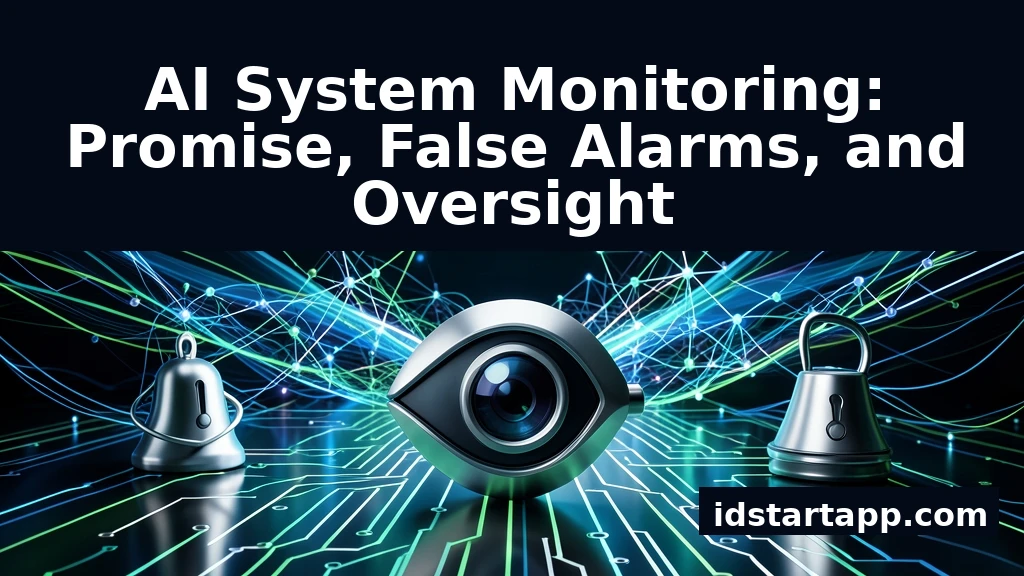
Modern software systems produce more telemetry than any team can read by hand. Metrics, logs, and traces arrive continuously from containers, serverless functions, databases, and third-party APIs. The promise of AI-based monitoring is straightforward: feed all of that data into a model, let it learn what normal looks like, and have it flag deviations before users notice. Recent coverage by PBS NewsHour asked whether AI tools that detect flaws in computer systems are themselves contributing to more technology outages and disruptions. The question matters because monitoring is only half the job. What happens after an alert fires—who responds, what they change, and whether automation acts first—determines whether AI makes systems more reliable or more fragile. This article explains what AI-based monitoring does well, where it goes wrong, and how engineering teams can use it with appropriate oversight.
How AI-Based System Monitoring Works
Traditional monitoring relies on static thresholds: alert when CPU exceeds 85 percent, when response time passes two seconds, or when error rate climbs above one percent. Thresholds are easy to understand but brittle. A system can be unhealthy while every individual metric stays below its limit, and a harmless seasonal spike can trigger a page at 3 a.m.
AI-based monitoring approaches the problem differently. Models ingest streams of metrics, log events, and distributed traces, then learn baseline behavior across time of day, day of week, and deployment patterns. Instead of fixed thresholds, the system flags statistical deviations: a memory curve that climbs unusually fast, a database query pattern that diverges from the past week, a sudden correlation between errors in two previously independent services.
The output is typically a risk score or anomaly flag, not a diagnosis. Engineers still must interpret the signal and decide what to do.
Where AI Monitoring Delivers Real Value
The strongest case for AI monitoring is pattern detection at scale. A microservices architecture can emit millions of log lines per hour; no human reads them all. Anomaly detection can surface rare error combinations that span services, time zones, or deployments—issues that sit quietly until they cause an incident.
It also helps with gradual degradation. Memory leaks, slow query creep, and connection pool exhaustion develop over days or weeks. Static thresholds miss slow changes because each reading looks normal in isolation. Models trained on historical data notice the drift.
AI monitoring is useful for correlating alerts during incidents. When a large-scale failure occurs, monitoring tools often fire hundreds of alerts simultaneously. Clustering and correlation can point engineers toward the root cause instead of the first symptom they see. These capabilities reduce mean time to detection when they are tuned well.
The False Alarm Problem
False alarms are the central practical problem. A model that flags five percent of observations as anomalous will generate thousands of alerts per week on a busy system. If most are benign, engineers learn to ignore them, and genuine incidents get lost in the noise.
False positives come from several sources. Seasonal behavior—end-of-month batch jobs, traffic spikes after a marketing campaign, backup windows—looks like an anomaly to a model that has not seen enough cycles. Deployments change the baseline: a new feature that legitimately uses more memory can be flagged as a leak. Model drift happens when the system itself evolves and yesterday's normal becomes today's anomaly.
Novel failures are the mirror problem. Models learn from past incidents, so a failure mode the system has never seen may look perfectly normal. AI monitoring is better at catching known classes of problems in new data than at warning about entirely new failure modes.
When Automation Makes Outages Worse
Detection is only half the loop. Many teams pair AI monitoring with automated remediation: restart a service, scale a cluster, roll back a deployment, or kill a consuming pod. Automation is fast, but it has no context.
An anomaly score might spike because a legitimate batch job is using extra memory. An automated system may restart the job mid-run, wasting hours of compute and delaying downstream pipelines. A correlated error burst across services may look like a cascading failure and trigger a rollback of a healthy release. Auto-scaling rules can add nodes to a cluster whose real problem is a poorly indexed database query, increasing cost without fixing latency.
Automated actions can also obscure the root cause. By the time an engineer investigates, the system has already changed, logs have rolled, and the incident timeline is harder to reconstruct. Automation should act on well-understood, low-risk scenarios only—never on an anomaly score alone.
Human Oversight and Escalation Practices
AI monitoring works best as decision support, not as an automatic operator. Human oversight means a person reviews alerts before consequential actions, and on-call engineers retain final authority over restarts, rollbacks, and scaling changes.
Practical guardrails include requiring human approval for any action that changes production traffic or capacity, keeping runbooks that list likely causes for each alert type, escalating repeated false positives to the team that owns the monitoring configuration, and reviewing every incident afterward to decide whether the alert should have fired at all.
Oversight also applies to the model itself. Teams should know what data the model was trained on, how often it is retrained, and which failure modes it was designed to catch. Monitoring the monitor—tracking alert volume, false positive rate, and mean time to acknowledge—turns AI monitoring from a black box into a manageable part of the stack.
Practical Steps for Engineering Teams
Adopt AI monitoring in stages. Start with dashboards and alerts that notify but do not act. Run the model in shadow mode for weeks: compare its anomaly flags against actual incidents and measure the false positive rate before trusting it in production.
Define service level objectives first. An alert should connect to a user-visible outcome—latency, error rate, availability—rather than to a model score in isolation. Set thresholds for action: which anomalies warrant a ticket, which wake an on-call engineer, and which trigger automated remediation.
Review false positives weekly during the first months. Each ignored alert is data that the tuning process needs. Document which deployments, traffic patterns, and seasonal events reliably trigger false alarms, and adjust the model or suppression rules accordingly.
Finally, keep humans in the incident loop. Automated actions should be logged, reversible, and announced in the incident channel so engineers know what changed and why.
Conclusion
AI-based monitoring can detect flaws faster than any dashboard of static thresholds, but it does not remove the need for human judgment. False alarms erode trust, and automated remediation can turn a small anomaly into a real outage. Teams that treat AI monitoring as one input among many—with clear escalation paths, tuned thresholds, and a person accountable for decisions—get the benefit without the risk. The goal is not to detect every anomaly; it is to detect the anomalies that matter, and respond to them sensibly.
Frequently Asked Questions
Does AI monitoring replace traditional alerting?
No. It works best alongside threshold-based alerts, dashboards, and human on-call processes.
Can automated remediation act on every alert?
No. Reserve automation for low-risk, well-understood actions; consequential changes should need human approval.
Why do AI monitoring systems produce false alarms?
Seasonal traffic, legitimate deployments, model drift, and unfamiliar failure modes can all look like anomalies to the model.